
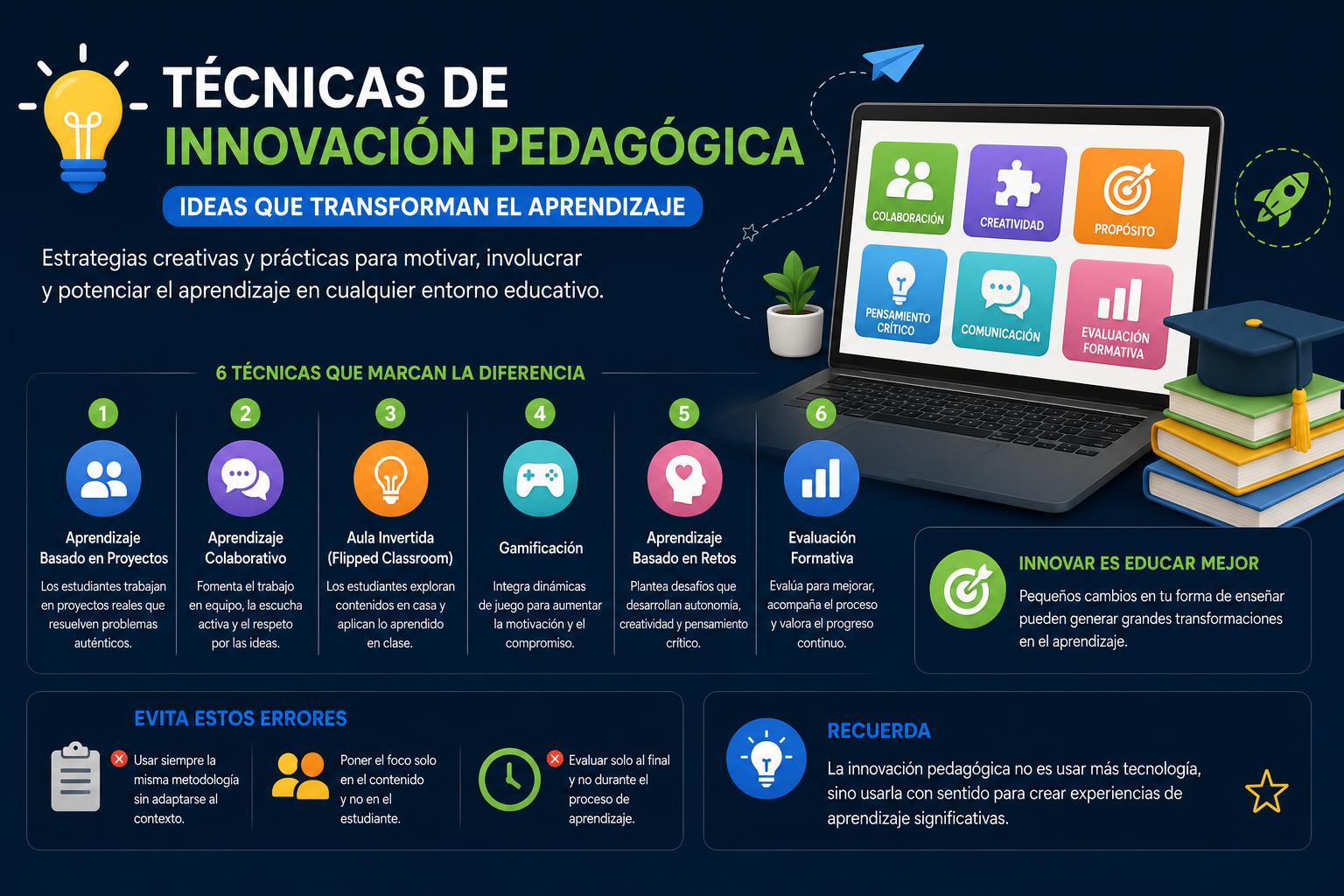
- Pedagogical innovation encompasses active methodologies, technology, and personalized learning.
- Methodologies such as project based learning, Gamification flipped classrooms place the student at the center
- The main challenges include teacher training, equitable digital access, and a collaborative culture of innovation.
The education system is currently undergoing profound changes driven by the rapid pace of technological advancement and the demands of an increasingly complex society. Understanding and applying innovative teaching techniques is essential for teachers and schools not only to adapt but also to become key players in this transformation. If you want to learn about all the key principles, methodologies, and current examples that are revolutionizing teaching, here is a comprehensive and in-depth guide.
Exploring pedagogical innovation involves more than just using new tools or acquiring more digital resources . True change lies in adapting teaching and learning processes to the realities, needs, and expectations of today's students, who learn and engage with knowledge in very different ways. Therefore, it is crucial to understand the different types of innovation available, how to implement them, and their real benefits at both the individual and institutional levels.
What is pedagogical innovation and why is it essential?
The concept of pedagogical innovation goes far beyond a simple technological upgrade or the introduction of new materials. It involves rethinking entire educational strategies and processes to ensure a truly meaningful and motivating education that is aligned with current and future challenges . This entails transforming everything from the organization of the subject matter and the role of the teacher to assessment, interaction methods, and the relationship between school and community.
Educational innovation can be applied in various areas: from modifying content and rethinking methodologies to integrating technologies and developing digital skills. Its purpose is to improve educational quality, capture students' interest, foster creativity and problem-solving, and reduce the digital divide . This approach gives rise to new practices that, far from discarding previous methods, improve and update education so that no student is left behind.
Dimensions and pillars of educational innovation
According to experts and top universities, pedagogical innovation operates on several fronts:
- Content: It transforms the syllabi and materials to make them meaningful, attractive and close to the students' reality (such as visual materials, videos, simulations...).
- Methodology: It renews teaching approaches, promoting the participación, experimentación and the active role of the student, replacing the traditional lecture with interactive strategies.
- Technology: promotes the intelligent and responsible use of ICT, betting on the digital training throughout the educational community, including resources such as pedagogy.
These pillars seek to modernize education, empower students and teachers, and, above all, prepare for a society that demands adaptability, critical thinking, and creativity.
Types of pedagogical innovation according to their impact
Not all innovative strategies are the same—neither in terms of objectives nor scope. According to experts like Murillo (2017) and international experiences, there are different types:
- Revolutionary innovation: It represents a radical change in the way of teaching and learning, adopting new paradigms or pedagogical models.
- Disruptive innovation: It completely transforms educational methods and relationships. This type of innovation takes educators out of their comfort zone and poses challenges, fundamentally reshaping learning.
- Incremental innovation: It introduces solid but less drastic improvements, progressively refining and updating aspects of the education system, such as assessment tools or classroom interaction.
- Continuous improvement innovation: It is based on small, successive modifications, focused on adjusting specific details without profoundly altering the structure.
The key is not just to apply one or the other, but to combine them so that innovation becomes a living, adaptive, and sustainable process.
Examples and techniques of the most relevant pedagogical innovation
Active techniques for meaningful learning
Active learning methodologies have become the most successful strategies for transforming education . What do they consist of?
These techniques make the student the protagonist of their learning : they no longer just listen, but investigate, create, test, collaborate, and reflect on the knowledge. Evidence indicates that this active role improves attention, engagement, and retention . Active learning methodologies include:
- Project-based learningIt focuses on solving problems or creating projects linked to reality, developing skills such as critical thinking, creativity, and collaborationThe student investigates, designs, experiments, and presents what they have learned as a team, emulating the challenges of the adult world.
- Collaborative and peer learningIt fosters teamwork, where each student contributes from their unique perspective. Peer interaction promotes deep learning and strengthens social and communication skills.
- GamificationIt introduces game-like dynamics, such as challenges, scores, and rewards, to transform the classroom into a playful space, increase motivation, and facilitate the assimilation of complex content.
- Flipped ClassroomIt reverses the traditional order, so that theoretical content is learned outside the classroom (through videos, readings, digital resources) and class time is used for practical activities, debate, resolving doubts and collaborative projects.
- Educational coachingThe teacher acts as a guide or coachhelping students discover answers, set goals, and reflect on their own learning process.
- personalized teachingIt adapts to the pace of each student through differentiated itineraries and activities, offering continuous individual support to maximize each student's learning.
- Emotional EducationWorking on emotional intelligence and emotion management in the classroom has proven essential to make learning possible and manageable for everyone.
The essential role of technology and digital personalization
Another major driver of educational transformation is the integration of digital resources. Emerging technologies open doors to personalization, efficiency, and creativity in the classroom.
- Augmented reality and virtual reality: They allow you to live immersive experiences, explore virtual historical, scientific or medical worlds and practice skills in safe environments (especially useful in vocational training and STEM).
- Adaptive platforms: Online systems that apply algorithms to propose customized learning paths for each student, allowing a unprecedented personalization of learning.
- Educational analytics and artificial intelligence: They collect and analyze large amounts of data on student progress, helping to detect difficulties and guide educational action in real time.
- Digital gamification: Resources, online games and applications that bring the motivation of play to any subject or educational level, with scoreboards, weekly challenges, rewards, etc.
Examples of innovative resources and projects include AporTICs: a collaborative project to share tutorials, resources and experiences on the use of ICT in education, Apps for Good: promotes the development of technological applications created by students seeking to solve problems in the environment, or Science Lab: an online platform to experiment with virtual science laboratories, increasing interest in STEM subjects from an early age.
Main advantages and benefits of pedagogical innovation
The implementation of innovative techniques in the education system generates numerous direct and indirect benefits for students, teachers, and schools:
- It increases motivation and a positive attitude towards learning, reducing dropout rates and absenteeism.
- It facilitates the understanding of complex content and improves the development of key skills such as collaboration, critical analysis, and resilience.
- It allows addressing the diversity of the student body, adapting better to different rhythms, styles and needs.
- It encourages experimentation, creativity, and decision-making.replicating real or professional environments and situations in the classroom.
- Develop digital skills and prepares students for a globalized and changing world.
Furthermore, educational innovation helps teachers stay up-to-date and motivated through ongoing training and the exchange of best practices.
Difficulties and challenges for the effective implementation of innovation
Despite the benefits, the incorporation of these techniques is not without its obstacles. Among the most common challenges are:
- Need for adequate training for teachers: Integrating new tools and methodologies requires ongoing training programs, personalized support, and spaces for experimentation.
- Resistance to change in the educational community: Teachers, students, and families may all show some reluctance due to inertia or lack of knowledge. It is essential to encourage... culture of innovation and collaboration.
- Inequality in access to technological infrastructure: The digital divide is still a reality. It is necessary to guarantee equity by ensuring connectivity, devices, and resources, even in the most disadvantaged contexts.
- Institutional planning and support: Any innovation strategy must be linked to a clear vision, leadership, and continuous evaluation of results.
Projects, experiences and specific cases of educational innovation
Project-based and real-world problem-based learning
Project-based learning is one of the most widespread approaches today. It involves engaging students in the planning, development, and evaluation of projects linked to real-world problems. This can range from scientific research to the creation of digital applications, including business simulations, robotics, or community action. The practical application of knowledge is undoubtedly one of its greatest strengths.
Alongside it, problem-based learning allows students to analyze complex situations, search for information, debate and make decisions in a controlled but realistic environment.
Educational gamification: learning through play
Gamification in education uses elements such as badges, challenges, levels, and leaderboards to motivate and engage students. It's not just about playing games, but about transferring the motivational mechanisms of games to any subject. Its effects include greater engagement, less stress, and a collaborative environment. Furthermore, it can be adapted to any educational stage, from primary school to postgraduate studies.
Numerous centers have reported improvements in participation, group cohesion, and academic results thanks to gamification.
Flipped classroom methodology and active learning
The flipped classroom has completely changed the way classrooms are used and structured. Students access theoretical content outside of class (using digital platforms, videos, and interactive resources) and use in-person time to resolve doubts, delve deeper into the subject, and experiment through practical activities. This model fosters autonomy, facilitates individualized attention, and enhances meaningful learning.
Collaborative work and peer work
Collaborative techniques transform classroom group dynamics. Students of varying abilities work together, support each other, solve challenges, communicate, and make decisions jointly. Peer learning is highly effective and fosters inclusion and community building!
Integration of emotional intelligence
Addressing emotions in the classroom is no longer an option, but a necessity. Managing frustration, maintaining motivation, developing self-concept and empathy, and resolving conflicts are essential skills for educational and personal success.
Inspiring projects and resources
- A collaborative project to share tutorials, resources and experiences on the use of ICT in education.
- It promotes the development of technological applications created by students seeking to solve problems in their environment.
- An online platform to experiment with virtual science labs, increasing interest in STEM subjects from an early age.
These proposals demonstrate that educational innovation can materialize into tangible projects with a strong impact on students' skills and engagement , using resources like Curipod.
How to promote innovation in educational centers: practical keys
Knowing the techniques is not enough: it is essential to know how to implement them so that they have a real impact and are sustainable:
- Continuing professional development for teachersWorkshops, seminars, and mentoring on new methodologies, platform use, assessment tools, and digital leadership, such as classroom management.
- Creating professional learning communities within the faculty: spaces for exchanging good practices, joint reflection and teamwork so that innovation does not depend on scattered individual efforts.
- Development of mentoring programs, peer tutoring y coaching: both among teachers and among students, to take advantage of peer learning and shared motivation.
- Continuous evaluation and adjustment of practices: measure results, collect evidence and be open to constant improvement.
- Promote collaboration between school, family, and community: to involve all stakeholders and inform them about the benefits and achievements of educational innovation.
Complete guide to Acer for Education: Technology, Innovation and Sustainability in Teaching
How to overcome barriers and ensure equity in educational innovation
One of the most important challenges today is ensuring that no student is left behind by the opportunities that innovation offers . To achieve this, the following is key:
- Guarantee access to devices, connectivity and digital resources through equipment programs or partnerships with technology companies.
- Develop inclusive, accessible platforms and methodologies adapted to the diversity of contexts and abilities.
- Empowering digital training for families and teachersas well as personalized attention to the rhythms and needs of the students.
Social education: definition, areas, challenges and future of a key discipline
Skills and competencies that drive educational innovation
Innovative education not only transmits knowledge but also prepares students to navigate a changing society with ease . Skills such as critical thinking, communication, autonomy, emotional intelligence, creativity, adaptability, and the ethical use of technology are essential both in school and in the workplace. Therefore, innovative teaching methods are the best way to foster this holistic development.
Pedagogical innovation is much more than a trend: it's a commitment to providing students with an education that adapts to their pace, context, and needs, developing all the necessary skills for the future. Applying and combining different techniques and strategies is essential for building motivating, dynamic, and sustainable learning environments where each student is truly the protagonist . From active methodologies, technology, collaborative projects, and gamification, to fostering emotional intelligence, educational transformation is within reach of any school or teacher willing to lead the change.
What is pedagogy: meaning, history, branches and key tools