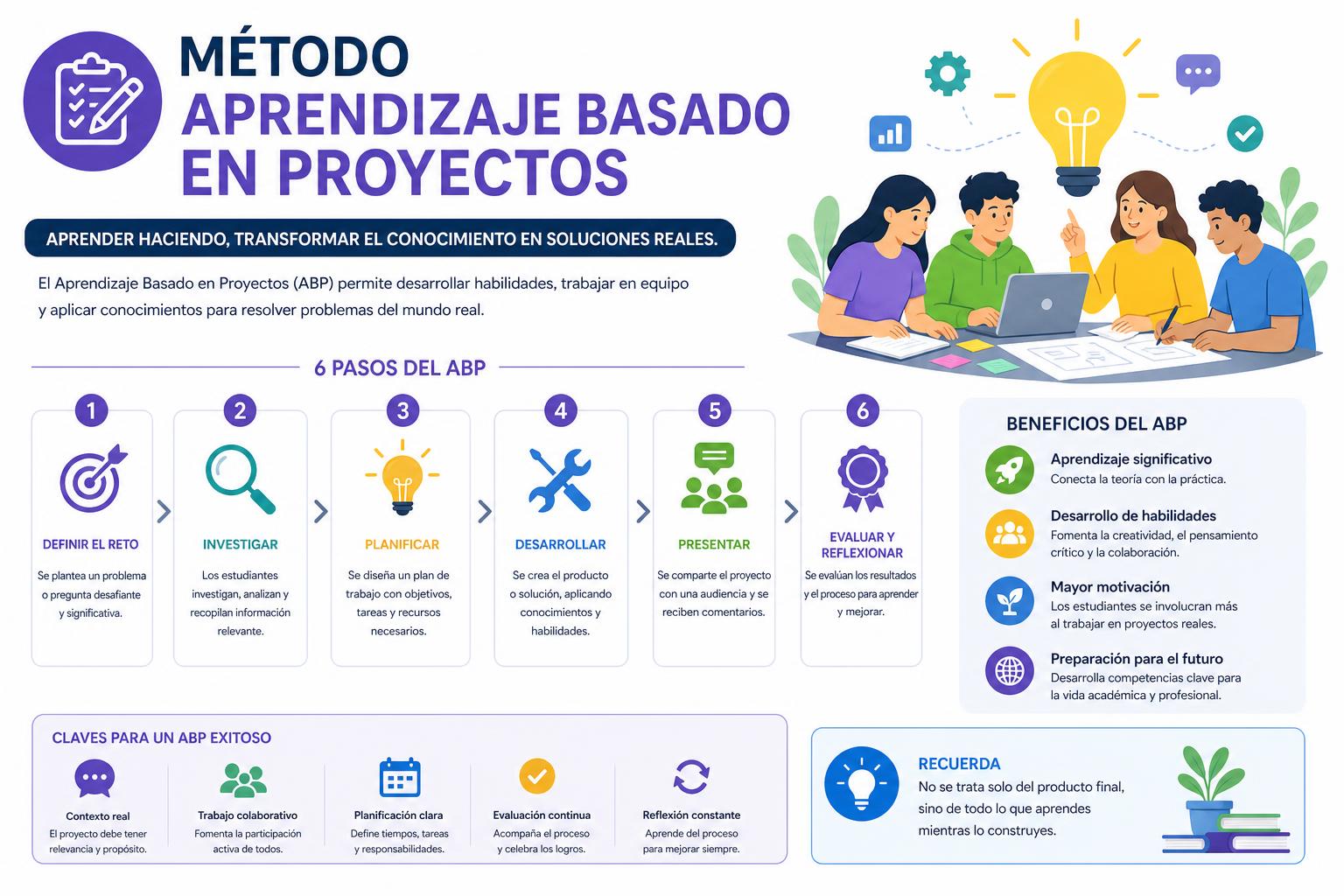
- The PBL method promotes active participation and meaningful learning.
- It allows you to connect theory and practice through challenges and projects adapted to real life.
- Develops key skills such as critical thinking, collaboration, and autonomy.
- PBL can be implemented at various educational stages with countless practical benefits.
Education is evolving at a rapid pace, and today one of the most powerful, recognized, and debated approaches is Project-Based Learning (PBL). Anyone who has set foot in a classroom lately has heard about PBL, whether as a methodological revolution, a fad, a miracle cure, or even as that method that seems difficult to implement effectively. And with good reason, because PBL is transforming the way we learn, teach, and assess.
What is Project-Based Learning?
Project -Based Learning ( PBL ) is an active educational methodology that focuses on hands-on learning through the execution and resolution of meaningful, real-world projects. In contrast to the more theoretical and rote-learning approach of traditional methods, PBL places the student at the center of the learning process , empowering them to take the lead in research, problem-solving, and the development of final products.
Problem-based learning (PBL) aims to move away from rote memorization and exams that rely solely on memorization. Here, students actively participate, inquire, plan, investigate, and construct knowledge, developing their cognitive, personal, and social skills. In fact, all of this is based on presenting a challenge or problem that connects to real life , and which involves a series of phases ranging from the initial formulation to the presentation and discussion of the final product.
Everything about Windows 11 Education: versions, advantages and differences for educational institutions and students
Brief history and evolution of PBL
Project-based learning (PBL) has deep roots in educational theory, particularly in the experiential approach championed by John Dewey in the early 20th century. Dewey argued that learning is best achieved through doing, and that education should foster real-life experiences . Years later, William Heard Kilpatrick popularized the concept in his work "The Project Method," extending it to schools of architecture, and subsequently to engineering and other disciplines, both in Europe and America.
What is Scratch: a complete guide to the visual programming language for learning by creating
Over time, PBL has been integrated into different educational systems and extended to various educational stages , from early childhood education to university and vocational training. The methodology gained new momentum in the 1960s and 70s, and with the emergence of digital technology and globalization, interest in PBL has continued to grow, leading it to be considered one of the most promising models for the 21st century.
What exactly does the ABP method consist of?
Project-based learning (PBL) is a way of organizing learning around a relevant and realistic project , in which students must research, gather information, design products, make decisions, and finally present the results.
Google for Education: What it is, how it works, and how to implement it in educational institutions
The teacher's role is radically transformed in PBL: they cease to be the sole transmitter of knowledge and become a guide, facilitator, and designer of learning experiences. The teacher poses the challenge, accompanies the processes, and provides resources, support, and feedback, but it is the students who assume the responsibility for researching, organizing, and constructing the final product.
Typically, the dynamics of a PBL project include:
- Posing a question, challenge, or real problem: that connects with the students' interests and environment, and that does not have a single answer.
- Research and analysis phase: Students search for different sources of information, debate, compare ideas and make decisions using critical thinking.
- Final product development: It could be a report, a model, a presentation, a documentary, a guide, a video, or even an awareness campaign. The important thing is that the result transcends the classroom and is presented to an audience, real or simulated.
- Continuous assessment process: The path is evaluated both in the process and in the result, and may include self-evaluation, peer evaluation, use of rubrics, and collection of various evidence (portfolio, diaries, presentations…).
DeepSeek in Education: Uses, Comparisons, and Practical Tips for the Classroom
Characteristics and essential elements of PBL
For a project to be considered PBL and not simply a series of linked tasks, it must meet certain fundamental characteristics :
- Student protagonism: The students themselves are directly responsible for researching, deciding, developing, and presenting their learning. The student learns by doing.
- Authentic context: The project is linked to real-life situations outside the classroom, bringing the school or training center closer to life and the problems of the 21st century.
- Collaborative work: Teamwork is essential, fostering social skills, negotiation, co-responsibility, and communication.
- Critical thinking and creativity: The goal is for the challenge or question to require analysis, searching for alternatives, creating solutions, and justifying decisions.
- Guided research: Students should use different sources, select valid information, and build knowledge through inquiry.
- Final public product: The result of the project is presented to the rest of the class, the school, families, or even the community, which adds realism and challenge to the learning.
- Formative and authentic assessment: Both the process and the result are valued, using instruments such as rubrics, digital portfolios, learning diaries, questionnaires and peer assessments.
Main benefits of Project-Based Learning
Educational research and classroom experience from around the world have pointed to numerous benefits associated with PBL :
- Boosts motivation and commitment of the students, since they work on topics that interest them and have a real impact.
- Develop key skills and competenciesCritical thinking, creativity, collaboration, communication, time management, problem solving, decision making, and use of digital technologies.
- Improves knowledge retention and promotes meaningful learning, connecting theory with practice.
- It fosters self-esteem by allowing students to see the fruits of their labor and share them with others, both inside and outside the classroom.
- Prepares you for the world of work and real life, when faced with complex challenges where it is necessary to investigate, plan and present solutions.
- It promotes inclusion and attention to diversity, making it easier for each student to contribute according to their abilities, interests and learning pace.
- It increases satisfaction with learning. and improves the perception of the meaning of what is learned in class.
Innovation in Education: Methods, Examples and the Future of Teaching
Advantages and possible disadvantages of PBL: Is all that glitters gold?
The PBL model has many proponents who highlight its advantages in developing skills, increasing motivation, enriching practical knowledge, and opening learning to the real world. However, there are also critical voices and some common implementation problems:
- Complex implementation: Designing and organizing truly meaningful projects requires a significant effort from teachers. This is compounded by the need for training and support to successfully implement the methodology.
- Risk of saturation or lack of focus: Both students and teachers can feel overwhelmed if projects become excessively long, vague, or if there is no cross-curricular coordination between areas and subjects.
- Challenges in assessment: Measuring the learning of skills, and not just knowledge, requires alternative assessment tools and a different mindset than the traditional one.
- Balance between skills and content: One of the most prevalent debates is how to prevent the prioritization of skills from leading to an abandonment of essential disciplinary knowledge.
- Material and time conditions: In some contexts, classroom design, student-teacher ratios, or school organization may limit the effective application of PBL.
- Impact on academic results: prominent international reports, such as PISAThey point out that neither methodological innovation nor digital technologies have, in themselves, led to a direct improvement in academic performance, especially in mathematics and science. Context, the combination of methodologies, and curricular integration remain key aspects.
Therefore, it is essential that PBL be applied with flexibility and common sense, and that it be intelligently combined with other methodologies (such as lectures, case studies, and guided research) , in order to get the best of each approach and avoid falling into the trap of unrigorous trends.
Requirements and keys for a successful implementation of PBL
For PBL to work and not remain a superficial simulation , it is key to consider some aspects in its design and development:
- Relevant and authentic projects: The projects must be based on real situations, linked to the students' environment, and with a sufficiently stimulating challenge.
- Interdisciplinarity: It is recommended that, whenever possible, the project integrate several subjects and skills, in order to provide a global vision.
- Detailed planning: Both teachers and students must define the learning objectives, assessment criteria, necessary resources, and a realistic timeline.
- Continuous accompaniment: The teacher must guide the process and be available to resolve roadblocks, guide the research, and provide formative feedback.
- Explain the methodology to the students: Students need to know clearly what is expected of them, how the teams will be organized, how the evaluation will be conducted, and what roles they can take on.
- Promoting self-employment, but also collaborative work: Each student must take on responsibilities, but also commit to the group.
- Formative, comprehensive and varied assessment: Beyond grades, the collection of evidence, self-assessment, and peer assessment become especially important for improving the process.
- Technology Integration: the ICT They can be great allies for researching, creating digital products, communicating, and presenting results.
Phases and steps to develop a PBL project
A project based on the PBL method usually follows a well-defined phased structure:
- Statement of the challenge or driving question: It all begins with an open problem or a meaningful question. This question must require analysis, inquiry, and creativity, and it must connect with the reality of the surrounding environment.
- Organization and planning: The teaching team and the students identify what they know and what they need to know, plan the resources, divide tasks, and mark the main milestones.
- Research and experimentation: In this phase, students delve deeper into the topic, search for information (in books, the Internet, oral sources, interviews, fieldwork), experiment, compare, and select relevant data.
- Final product development: The group develops the final product: it can be a presentation, a physical object, a video, a report, a campaign… The important thing is that it has meaning and applicability outside the classroom.
- Presentation and dissemination: The product is presented to an audience (the class, the center, families, external professionals, the community), which adds an extra challenge and motivates quality.
- Evaluation, reflection and improvement: Both the process and the outcome are evaluated, using rubrics, portfolios, presentations and feedback. Students reflect on what they have learned, the challenges, the skills developed, and how they could improve.
Differences between PBL and other active methods: the case of Problem-Based Learning
It is common to find some confusion between PBL (Project-Based Learning) and PBL (Problem-Based Learning) . Although they share an essence and often overlap in practice, there are subtle but relevant differences:
- PBL focuses on solving a specific problem of a more limited duration, while PBL consists of developing a more extensive project that culminates in a visible final product.
- In PBL, the objective is the problem-solving and reasoning process.Whereas in PBL the process is as important as the final result, which has repercussions outside the classroom.
- PBL is more common in areas such as medicine, science, or engineeringwhere clinical or technical cases allow for the formulation of hypotheses and experiments.
- Project-based learning (PBL) typically seeks a transferable product, a work, an event, a proposal for improvement, or an awareness campaign..
However, in practice, many educational centers combine elements of both methods, adapting the sequence and characteristics to the objectives and resources of the context.
Examples of real PBL projects and by educational stage
To understand how all of the above can be translated into practice, there's nothing like seeing concrete examples, useful from the Early Childhood Education stage to High School and Vocational Training:
Project-Based Learning in Early Childhood Education (3-6 years)
- City Animal GuideStudents investigate which animals live nearby, gather information by asking at home or the teachers, draw the animals, create a small illustrated guide and present it to their families. See example on Wikipedia
Project-Based Learning in Primary Education (6-12 years)
- Redesign of the school playgroundStarting from the observation of the courtyard, the groups analyze its use, identify possible improvements, look for information on green courtyards, design a scale plan as a group and prepare a budget and an oral defense that they present to the management team. Detailed example
- Investigation into the pollution of a nearby riverAfter presenting a news report simulating the pollution of a river, the groups investigate causes, consequences and development of proposals, preparing reports and presentations to the 'City Council'.
Project-Based Learning in Compulsory Secondary Education (12-16 years old)
- Creation of a fictitious social enterpriseStudents analyze their environment, identify a real problem in the neighborhood, propose a business solution, design the business model, and end up presenting the project to a jury of professionals and teachers.
- Analysis of bottled water prices: Through the study and debate of actual headlines, the group investigates the economics, legal framework and social consequences of bottled water, organizing structured debates and written arguments.
Project-Based Learning in High School and Vocational Training
- Health education planIn health vocational training cycles, students design an education program on type 2 diabetes for patients of a center, develop materials, prepare presentations and organize a simulated event with participants outside their group.
- Clinical case simulation: The vocational training students in health emergencies solve diagnostic sequences, develop protocols and defend their clinical proposal before the teacher and the group.
Assessment in PBL: Beyond Traditional Exams
One of the most decisive transformations of PBL is the way learning is assessed . Instead of traditional written tests, PBL uses alternative and broader mechanisms, such as:
- Clear rubrics from the start, which make visible the criteria and expected quality levels for both the process and the final product.
- Self-assessment and peer assessmentwhere the students themselves and their peers assess participation, individual and group contributions, and challenges overcome.
- Learning journals and digital portfolios, collecting reflections, intermediate products, difficulties and achievements throughout the project.
- Oral presentations and project defenseswhich allow the development of key communication skills, the justification of ideas, and the receipt of feedback from the audience itself.
- Direct observation and collection of varied evidence (prototypes, videos, reports, digital campaigns…)
All of this involves moving from a purely final evaluation to a continuous formative evaluation , aimed at improvement throughout the entire process.
How does PBL combine with other methodologies?
Problem-based learning (PBL) is extremely flexible, and the most successful experiences often integrate or alternate phases of theoretical presentation, case studies, flipped classrooms, simulations, or guided discussions . It is also common to combine it with:
- Gamification: use of game dynamics and challenges in the development of the project
- Flipped classroomResources and prior explanations are proposed outside the classroom to dedicate face-to-face time to collaborative development.
- ICT and digital tools: to collaborate online, research, prototype, or creatively present the results.
- I work through integrated curricular areas, which facilitates the comprehensive approach to problems and projects.
Critical factors and key recommendations for teachers and schools
- Relevant and authentic projects: The projects must be based on real situations, linked to the students' environment, and with a sufficiently stimulating challenge.
- Interdisciplinarity: It is recommended that, whenever possible, the project integrate several subjects and skills, in order to provide a global vision.
- Detailed planning: Both teachers and students must define the learning objectives, assessment criteria, necessary resources, and a realistic timeline.
- Continuous accompaniment: The teacher must guide the process and be available to resolve roadblocks, guide the research, and provide formative feedback.
- Explain the methodology to the students: Students need to know clearly what is expected of them, how the teams will be organized, how the evaluation will be conducted, and what roles they can take on.
- Promoting self-employment, but also collaborative work: Each student must take on responsibilities, but also commit to the group.
- Formative, comprehensive and varied assessment: Beyond grades, the collection of evidence, self-assessment, and peer assessment become especially important for improving the process.
- Technology Integration: ICTs can be great allies for researching, creating digital products, communicating and presenting results.
Phases and steps to develop a PBL project
A project based on the PBL method usually follows a well-defined phased structure:
- Statement of the challenge or driving question: It all begins with an open problem or a meaningful question. This question must require analysis, inquiry, and creativity, and it must connect with the reality of the surrounding environment.
- Organization and planning: The teaching team and the students identify what they know and what they need to know, plan the resources, divide tasks, and mark the main milestones.
- Research and experimentation: In this phase, students delve deeper into the topic, search for information (in books, the Internet, oral sources, interviews, fieldwork), experiment, compare, and select relevant data.
- Final product development: The group develops the final product: it can be a presentation, a physical object, a video, a report, a campaign… The important thing is that it has meaning and applicability outside the classroom.
- Presentation and dissemination: The product is presented to an audience (the class, the center, families, external professionals, the community), which adds an extra challenge and motivates quality.
- Evaluation, reflection and improvement: Both the process and the outcome are assessed using rubrics, portfolios, presentations, and feedback. Students reflect on what they have learned, the challenges they have faced, the skills they have developed, and how they could improve.
Differences between PBL and other active methods: the case of Problem-Based Learning
It is common to find some confusion between PBL (Project-Based Learning) and PBL (Problem-Based Learning) . Although they share an essence and often overlap in practice, there are subtle but relevant differences:
- PBL focuses on solving a specific problem of a more limited duration, while PBL consists of developing a more extensive project that culminates in a visible final product.
- In PBL, the objective is the problem-solving and reasoning process.Whereas in PBL the process is as important as the final result, which has repercussions outside the classroom.
- PBL is more common in areas such as medicine, science, or engineeringwhere clinical or technical cases allow for the formulation of hypotheses and experiments.
- Project-based learning (PBL) typically seeks a transferable product, a work, an event, a proposal for improvement, or an awareness campaign..
However, in practice, many educational centers combine elements of both methods, adapting the sequence and characteristics to the objectives and resources of the context.
Examples of real PBL projects and by educational stage
To understand how all of the above can be translated into practice, there's nothing like seeing concrete examples, useful from the Early Childhood Education stage to High School and Vocational Training:
Project-Based Learning in Early Childhood Education (3-6 years)
- City Animal GuideStudents investigate which animals live nearby, gather information by asking at home or the teachers, draw the animals, create a small illustrated guide and present it to their families.
Project-Based Learning in Primary Education (6-12 years)
- Redesign of the school playgroundStarting from the observation of the courtyard, the groups analyze its use, identify possible improvements, look for information on green courtyards, design a scale plan as a group and prepare a budget and an oral defense that they present to the management team.
- Investigation into the pollution of a nearby riverAfter presenting a news report simulating the pollution of a river, the groups investigate causes, consequences and development of proposals, preparing reports and presentations to the 'City Council'.
Project-Based Learning in Compulsory Secondary Education (12-16 years old)
- Creation of a fictitious social enterpriseStudents analyze their environment, identify a real problem in the neighborhood, propose a business solution, design the business model, and end up presenting the project to a jury of professionals and teachers.
- Analysis of bottled water prices: Through the study and debate of actual headlines, the group investigates the economics, legal framework and social consequences of bottled water, organizing structured debates and written arguments.
Project-Based Learning in High School and Vocational Training
- Health education planIn health vocational training cycles, students design an education program on type 2 diabetes for patients of a center, develop materials, prepare presentations and organize a simulated event with participants outside their group.
- Clinical case simulation: The vocational training students in health emergencies solve diagnostic sequences, develop protocols and defend their clinical proposal before the teacher and the group.
Assessment in PBL: Beyond Traditional Exams
One of the most decisive transformations of PBL is the way learning is assessed . Instead of traditional written tests, PBL uses alternative and broader mechanisms, such as:
- Clear rubrics from the start, which make visible the criteria and expected quality levels for both the process and the final product.
- Self-assessment and peer assessmentwhere the students themselves and their peers assess participation, individual and group contributions, and challenges overcome.
- Learning journals and digital portfolios, collecting reflections, intermediate products, difficulties and achievements throughout the project.
- Oral presentations and project defenseswhich allow the development of key communication skills, the justification of ideas, and the receipt of feedback from the audience itself.
- Direct observation and collection of varied evidence (prototypes, videos, reports, digital campaigns…)
All of this involves moving from a purely final evaluation to a continuous formative evaluation , aimed at improvement throughout the entire process.
How does PBL combine with other methodologies?
Problem-based learning (PBL) is extremely flexible, and the most successful experiences often integrate or alternate phases of theoretical presentation, case studies, flipped classrooms, simulations, or guided discussions . It is also common to combine it with:
- Gamification: use of game dynamics and challenges in the development of the project
- Flipped classroomResources and prior explanations are proposed outside the classroom to dedicate face-to-face time to collaborative development.
- ICT and digital tools: to collaborate online, research, prototype, or creatively present the results.
- I work through integrated curricular areas, which facilitates the comprehensive approach to problems and projects.
Critical factors and key recommendations for teachers and schools
- Relevant and authentic projects: The projects must be based on real situations, linked to the students' environment, and with a sufficiently stimulating challenge.
- Interdisciplinarity: It is recommended that, whenever possible, the project integrate several subjects and skills, in order to provide a global vision.
- Detailed planning: Both teachers and students must define the learning objectives, assessment criteria, necessary resources, and a realistic timeline.
- Continuous accompaniment: The teacher must guide the process and be available to resolve roadblocks, guide the research, and provide formative feedback.
- Explain the methodology to the students: Students need to know clearly what is expected of them, how the teams will be organized, how the evaluation will be conducted, and what roles they can take on.
- Promoting self-employment, but also collaborative work: Each student must take on responsibilities, but also commit to the group.
- Formative, comprehensive and varied assessment: Beyond grades, the collection of evidence, self-assessment, and peer assessment become especially important for improving the process.
- Technology Integration: ICTs can be great allies for researching, creating digital products, communicating and presenting results.
Phases and steps to develop a PBL project
A project based on the PBL method usually follows a well-defined phased structure:
- Statement of the challenge or driving question: It all begins with an open problem or a meaningful question. This question must require analysis, inquiry, and creativity, and it must connect with the reality of the surrounding environment.
- Organization and planning: The teaching team and the students identify what they know and what they need to know, plan the resources, divide tasks, and mark the main milestones.
- Research and experimentation: In this phase, students delve deeper into the topic, search for information (in books, the Internet, oral sources, interviews, fieldwork), experiment, compare, and select relevant data.
- Final product development: The group develops the final product: it can be a presentation, a physical object, a video, a report, a campaign… The important thing is that it has meaning and applicability outside the classroom.
- Presentation and dissemination: The product is presented to an audience (the class, the center, families, external professionals, the community), which adds an extra challenge and motivates quality.
- Evaluation, reflection and improvement: Both the process and the outcome are assessed using rubrics, portfolios, presentations, and feedback. Students reflect on what they have learned, the challenges they have faced, the skills they have developed, and how they could improve.
Differences between PBL and other active methods: the case of Problem-Based Learning
It is common to find some confusion between PBL (Project-Based Learning) and PBL (Problem-Based Learning) . Although they share an essence and often overlap in practice, there are subtle but relevant differences:
- PBL focuses on solving a specific problem of a more limited duration, while PBL consists of developing a more extensive project that culminates in a visible final product.
- In PBL, the objective is the problem-solving and reasoning process.Whereas in PBL the process is as important as the final result, which has repercussions outside the classroom.
- PBL is more common in areas such as medicine, science, or engineeringwhere clinical or technical cases allow for the formulation of hypotheses and experiments.
- Project-based learning (PBL) typically seeks a transferable product, a work, an event, a proposal for improvement, or an awareness campaign..
However, in practice, many educational centers combine elements of both methods, adapting the sequence and characteristics to the objectives and resources of the context.
Examples of real PBL projects and by educational stage
To understand how all of the above can be translated into practice, there's nothing like seeing concrete examples, useful from the Early Childhood Education stage to High School and Vocational Training:
Project-Based Learning in Early Childhood Education (3-6 years)
- City Animal GuideStudents investigate which animals live nearby, gather information by asking at home or the teachers, draw the animals, create a small illustrated guide and present it to their families.
Project-Based Learning in Primary Education (6-12 years)
- Redesign of the school playgroundStarting from the observation of the courtyard, the groups analyze its use, identify possible improvements, look for information on green courtyards, design a scale plan as a group and prepare a budget and an oral defense that they present to the management team.
- Investigation into the pollution of a nearby riverAfter presenting a news report simulating the pollution of a river, the groups investigate causes, consequences and development of proposals, preparing reports and presentations to the 'City Council'.
Project-Based Learning in Compulsory Secondary Education (12-16 years old)
- Creation of a fictitious social enterpriseStudents analyze their environment, identify a real problem in the neighborhood, propose a business solution, design the business model, and end up presenting the project to a jury of professionals and teachers.
- Analysis of bottled water prices: Through the study and debate of actual headlines, the group investigates the economics, legal framework and social consequences of bottled water, organizing structured debates and written arguments.
Project-Based Learning in High School and Vocational Training
- Health education planIn health vocational training cycles, students design an education program on type 2 diabetes for patients of a center, develop materials, prepare presentations and organize a simulated event with participants outside their group.
- Clinical case simulation: The vocational training students in health emergencies solve diagnostic sequences, develop protocols and defend their clinical proposal before the teacher and the group.
Assessment in PBL: Beyond Traditional Exams
One of the most decisive transformations of PBL is the way learning is assessed . Instead of traditional written tests, PBL uses alternative and broader mechanisms, such as:
- Clear rubrics from the start, which make visible the criteria and expected quality levels for both the process and the final product.
- Self-assessment and peer assessmentwhere the students themselves and their peers assess participation, individual and group contributions, and challenges overcome.
- Learning journals and digital portfolios, collecting reflections, intermediate products, difficulties and achievements throughout the project.
- Oral presentations and project defenseswhich allow the development of key communication skills, the justification of ideas, and the receipt of feedback from the audience itself.
- Direct observation and collection of varied evidence (prototypes, videos, reports, digital campaigns…)
All of this involves moving from a purely final evaluation to a continuous formative evaluation , aimed at improvement throughout the entire process.
How does PBL combine with other methodologies?
Problem-based learning (PBL) is extremely flexible, and the most successful experiences often integrate or alternate phases of theoretical presentation, case studies, flipped classrooms, simulations, or guided discussions . It is also common to combine it with:
- Gamification: use of game dynamics and challenges in the development of the project
- Flipped classroomResources and prior explanations are proposed outside the classroom to dedicate face-to-face time to collaborative development.
- ICT and digital tools: to collaborate online, research, prototype, or creatively present the results.
- I work through integrated curricular areas, which facilitates the comprehensive approach to problems and projects.
Critical factors and key recommendations for teachers and schools
- Relevant and authentic projects: The projects must be based on real situations, linked to the students' environment, and with a sufficiently stimulating challenge.
- Interdisciplinarity: It is recommended that, whenever possible, the project integrate several subjects and skills, in order to provide a global vision.
- Detailed planning: Both teachers and students must define the learning objectives, assessment criteria, necessary resources, and a realistic timeline.
- Continuous accompaniment: The teacher must guide the process and be available to resolve roadblocks, guide the research, and provide formative feedback.
- Explain the methodology to the students: Students need to know clearly what is expected of them, how the teams will be organized, how the evaluation will be conducted, and what roles they can take on.
- Promoting self-employment, but also collaborative work: Each student must take on responsibilities, but also commit to the group.
- Formative, comprehensive and varied assessment: Beyond grades, the collection of evidence, self-assessment, and peer assessment become especially important for improving the process.
- Technology Integration: ICTs can be great allies for researching, creating digital products, communicating and presenting results.
Phases and steps to develop a PBL project
A project based on the PBL method usually follows a well-defined phased structure:
- Statement of the challenge or driving question: It all begins with an open problem or a meaningful question. This question must require analysis, inquiry, and creativity, and it must connect with the reality of the surrounding environment.
- Organization and planning: The teaching team and the students identify what they know and what they need to know, plan the resources, divide tasks, and mark the main milestones.
- Research and experimentation: In this phase, students delve deeper into the topic, search for information (in books, the Internet, oral sources, interviews, fieldwork), experiment, compare, and select relevant data.
- Final product development: The group develops the final product: it can be a presentation, a physical object, a video, a report, a campaign… The important thing is that it has meaning and applicability outside the classroom.
- Presentation and dissemination: The product is presented to an audience (the class, the center, families, external professionals, the community), which adds an extra challenge and motivates quality.
- Evaluation, reflection and improvement: Both the process and the outcome are assessed using rubrics, portfolios, presentations, and feedback. Students reflect on what they have learned, the challenges they have faced, the skills they have developed, and how they could improve.
Differences between PBL and other active methods: the case of Problem-Based Learning
It is common to find some confusion between PBL (Project-Based Learning) and PBL (Problem-Based Learning) . Although they share an essence and often overlap in practice, there are subtle but relevant differences:
- PBL focuses on solving a specific problem of a more limited duration, while PBL consists of developing a more extensive project that culminates in a visible final product.
- In PBL, the objective is the problem-solving and reasoning process.Whereas in PBL the process is as important as the final result, which has repercussions outside the classroom.
- PBL is more common in areas such as medicine, science, or engineeringwhere clinical or technical cases allow for the formulation of hypotheses and experiments.
- Project-based learning (PBL) typically seeks a transferable product, a work, an event, a proposal for improvement, or an awareness campaign..
However, in practice, many educational centers combine elements of both methods, adapting the sequence and characteristics to the objectives and resources of the context.
Examples of real PBL projects and by educational stage
To understand how all of the above can be translated into practice, there's nothing like seeing concrete examples, useful from the Early Childhood Education stage to High School and Vocational Training:
Project-Based Learning in Early Childhood Education (3-6 years)
- City Animal GuideStudents investigate which animals live nearby, gather information by asking at home or the teachers, draw the animals, create a small illustrated guide and present it to their families.
Project-Based Learning in Primary Education (6-12 years)
- Redesign of the school playgroundStarting from the observation of the courtyard, the groups analyze its use, identify possible improvements, look for information on green courtyards, design a scale plan as a group and prepare a budget and an oral defense that they present to the management team.
- Investigation into the pollution of a nearby riverAfter presenting a news report simulating the pollution of a river, the groups investigate causes, consequences and development of proposals, preparing reports and presentations to the 'City Council'.
Project-Based Learning in Compulsory Secondary Education (12-16 years old)
- Creation of a fictitious social enterpriseStudents analyze their environment, identify a real problem in the neighborhood, propose a business solution, design the business model, and end up presenting the project to a jury of professionals and teachers.
- Analysis of bottled water prices: Through the study and debate of actual headlines, the group investigates the economics, legal framework and social consequences of bottled water, organizing structured debates and written arguments.
Project-Based Learning in High School and Vocational Training
- Health education planIn health vocational training cycles, students design an education program on type 2 diabetes for patients of a center, develop materials, prepare presentations and organize a simulated event with participants outside their group.
- Clinical case simulation: The vocational training students in health emergencies solve diagnostic sequences, develop protocols and defend their clinical proposal before the teacher and the group.
Assessment in PBL: Beyond Traditional Exams
One of the most decisive transformations of PBL is the way learning is assessed . Instead of traditional written tests, PBL uses alternative and broader mechanisms, such as:
- Clear rubrics from the start, which make visible the criteria and expected quality levels for both the process and the final product.
- Self-assessment and peer assessmentwhere the students themselves and their peers assess participation, individual and group contributions, and challenges overcome.
- Learning journals and digital portfolios, collecting reflections, intermediate products, difficulties and achievements throughout the project.
- Oral presentations and project defenseswhich allow the development of key communication skills, the justification of ideas, and the receipt of feedback from the audience itself.
- Direct observation and collection of varied evidence (prototypes, videos, reports, digital campaigns…)
All of this involves moving from a purely final evaluation to a continuous formative evaluation , aimed at improvement throughout the entire process.
How does PBL combine with other methodologies?
Project-based learning (PBL) is extremely flexible, and the most successful experiences often integrate or alternate phases of theoretical presentation, case studies, flipped classrooms, simulations, or guided discussions . The incorporation of digital tools, such as Notion in Education and other platforms that facilitate project management and monitoring, is also common .
- I work through integrated curricular areas, which facilitates the comprehensive approach to problems and projects.
Critical factors and key recommendations for teachers and schools
- Relevant and authentic projects: The projects must be based on real situations, linked to the students' environment, and with a sufficiently stimulating challenge.
- Interdisciplinarity: It is recommended that, whenever possible, the project integrate several subjects and skills, in order to provide a global vision.
- Detailed planning: Both teachers and students must define the learning objectives, assessment criteria, necessary resources, and a realistic timeline.
- Continuous accompaniment: The teacher must guide the process and be available to resolve roadblocks, guide the research, and provide formative feedback.
- Explain the methodology to the students: Students need to know clearly what is expected of them, how the teams will be organized, how the evaluation will be conducted, and what roles they can take on.
- Promoting self-employment, but also collaborative work: Each student must take on responsibilities, but also commit to the group.
- Formative, comprehensive and varied assessment: Beyond grades, the collection of evidence, self-assessment, and peer assessment become especially important for improving the process.
- Technology Integration: ICTs can be great allies for researching, creating digital products, communicating and presenting results.
Phases and steps to develop a PBL project
A project based on the PBL method usually follows a well-defined phased structure:
- Statement of the challenge or driving question: It all begins with an open problem or a meaningful question. This question must require analysis, inquiry, and creativity, and it must connect with the reality of the surrounding environment.
- Organization and planning: The teaching team and the students identify what they know and what they need to know, plan the resources, divide tasks, and mark the main milestones.
- Research and experimentation: In this phase, students delve deeper into the topic, search for information (in books, the Internet, oral sources, interviews, fieldwork), experiment, compare, and select relevant data.
- Final product development: The group develops the final product: it can be a presentation, a physical object, a video, a report, a campaign… The important thing is that it has meaning and applicability outside the classroom.
- Presentation and dissemination: The product is presented to an audience (the class, the center, families, external professionals, the community), which adds an extra challenge and motivates quality.
- Evaluation, reflection and improvement: Both the process and the outcome are assessed using rubrics, portfolios, presentations, and feedback. Students reflect on what they have learned, the challenges they have faced, the skills they have developed, and how they could improve.
Differences between PBL and other active methods: the case of Problem-Based Learning
It is common to find some confusion between PBL (Project-Based Learning) and PBL (Problem-Based Learning) . Although they share an essence and often overlap in practice, there are subtle but relevant differences:
- PBL focuses on solving a specific problem of a more limited duration, while PBL consists of developing a more extensive project that culminates in a visible final product.
- In PBL, the objective is the problem-solving and reasoning process.Whereas in PBL the process is as important as the final result, which has repercussions outside the classroom.
- PBL is more common in areas such as medicine, science, or engineeringwhere clinical or technical cases allow for the formulation of hypotheses and experiments.
- Project-based learning (PBL) typically seeks a transferable product, a work, an event, a proposal for improvement, or an awareness campaign..
However, in practice, many educational centers combine elements of both methods, adapting the sequence and characteristics to the objectives and resources of the context.
Examples of real PBL projects and by educational stage
To understand how all of the above can be translated into practice, there's nothing like seeing concrete examples, useful from the Early Childhood Education stage to High School and Vocational Training:
Project-Based Learning in Early Childhood Education (3-6 years)
- City Animal GuideStudents investigate which animals live nearby, gather information by asking at home or the teachers, draw the animals, create a small illustrated guide and present it to their families.
Project-Based Learning in Primary Education (6-12 years)
- Redesign of the school playgroundStarting from the observation of the courtyard, the groups analyze its use, identify possible improvements, look for information on green courtyards, design a scale plan as a group and prepare a budget and an oral defense that they present to the management team.
- Investigation into the pollution of a nearby riverAfter presenting a news report simulating the pollution of a river, the groups investigate causes, consequences and development of proposals, preparing reports and presentations to the 'City Council'.
Project-Based Learning in Compulsory Secondary Education (12-16 years old)
- Creation of a fictitious social enterpriseStudents analyze their environment, identify a real problem in the neighborhood, propose a business solution, design the business model, and end up presenting the project to a jury of professionals and teachers.
- Analysis of bottled water prices: Through the study and debate of actual headlines, the group investigates the economics, legal framework and social consequences of bottled water, organizing structured debates and written arguments.
Project-Based Learning in High School and Vocational Training
- Health education planIn health vocational training cycles, students design an education program on type 2 diabetes for patients of a center, develop materials, prepare presentations and organize a simulated event with participants outside their group.
- Clinical case simulation: The vocational training students in health emergencies solve diagnostic sequences, develop protocols and defend their clinical proposal before the teacher and the group.
Assessment in PBL: Beyond Traditional Exams
One of the most decisive transformations of PBL is the way learning is assessed . Instead of traditional written tests, PBL uses alternative and broader mechanisms, such as:
- Clear rubrics from the start, which make visible the criteria and expected quality levels for both the process and the final product.
- Self-assessment and peer assessmentwhere the students themselves and their peers assess participation, individual and group contributions, and challenges overcome.
- Learning journals and digital portfolios, collecting reflections, intermediate products, difficulties and achievements throughout the project.
- Oral presentations and project defenseswhich allow the development of key communication skills, the justification of ideas, and the receipt of feedback from the audience itself.
- Direct observation and collection of varied evidence (prototypes, videos, reports, digital campaigns…)
All of this involves moving from a purely final evaluation to a continuous formative evaluation , aimed at improvement throughout the entire process.
How does PBL combine with other methodologies?
Problem-based learning (PBL) is extremely flexible, and the most successful experiences often integrate or alternate phases of theoretical presentation, case studies, flipped classrooms, simulations, or guided discussions . The incorporation of digital tools, such as [platform name] and other platforms that facilitate project management and monitoring, is also common.
- I work through integrated curricular areas, which facilitates the comprehensive approach to problems and projects.
Critical factors and key recommendations for teachers and schools
- Relevant and authentic projects: The projects must be based on real situations, linked to the students' environment, and with a sufficiently stimulating challenge.
- Interdisciplinarity: It is recommended that, whenever possible, the project integrate several subjects and skills, in order to provide a global vision.
- Detailed planning: Both teachers and students must define the learning objectives, assessment criteria, necessary resources, and a realistic timeline.
- Continuous accompaniment: The teacher must guide the process and be available to resolve roadblocks, guide the research, and provide formative feedback.
- Explain the methodology to the students: Students need to know clearly what is expected of them, how the teams will be organized, how the evaluation will be conducted, and what roles they can take on.
- Promoting self-employment, but also collaborative work: Each student must take on responsibilities, but also commit to the group.
- Formative, comprehensive and varied assessment: Beyond grades, the collection of evidence, self-assessment, and peer assessment become especially important for improving the process.
- Technology Integration: ICTs can be great allies for researching, creating digital products, communicating and presenting results.
Phases and steps to develop a PBL project
A project based on the PBL method usually follows a well-defined phased structure:
- Statement of the challenge or driving question: It all begins with an open problem or a meaningful question. This question must require analysis, inquiry, and creativity, and it must connect with the reality of the surrounding environment.
- Organization and planning: The teaching team and the students identify what they know and what they need to know, plan the resources, divide tasks, and mark the main milestones.
- Research and experimentation: In this phase, students delve deeper into the topic, search for information (in books, the Internet, oral sources, interviews, fieldwork), experiment, compare, and select relevant data.
- Final product development: The group develops the final product: it can be a presentation, a physical object, a video, a report, a campaign… The important thing is that it has meaning and applicability outside the classroom.
- Presentation and dissemination: The product is presented to an audience (the class, the center, families, external professionals, the community), which adds an extra challenge and motivates quality.
- Evaluation, reflection and improvement: Both the process and the outcome are assessed using rubrics, portfolios, presentations, and feedback. Students reflect on what they have learned, the challenges they have faced, the skills they have developed, and how they could improve.