
- There are educational apps for every need: management, concentration, creation, languages, and collaboration.
- Windows allows you to integrate traditional tools, AI, and collaborative platforms into a single ecosystem.
- Adapting digital education involves choosing safe, effective apps tailored to each center or user profile.
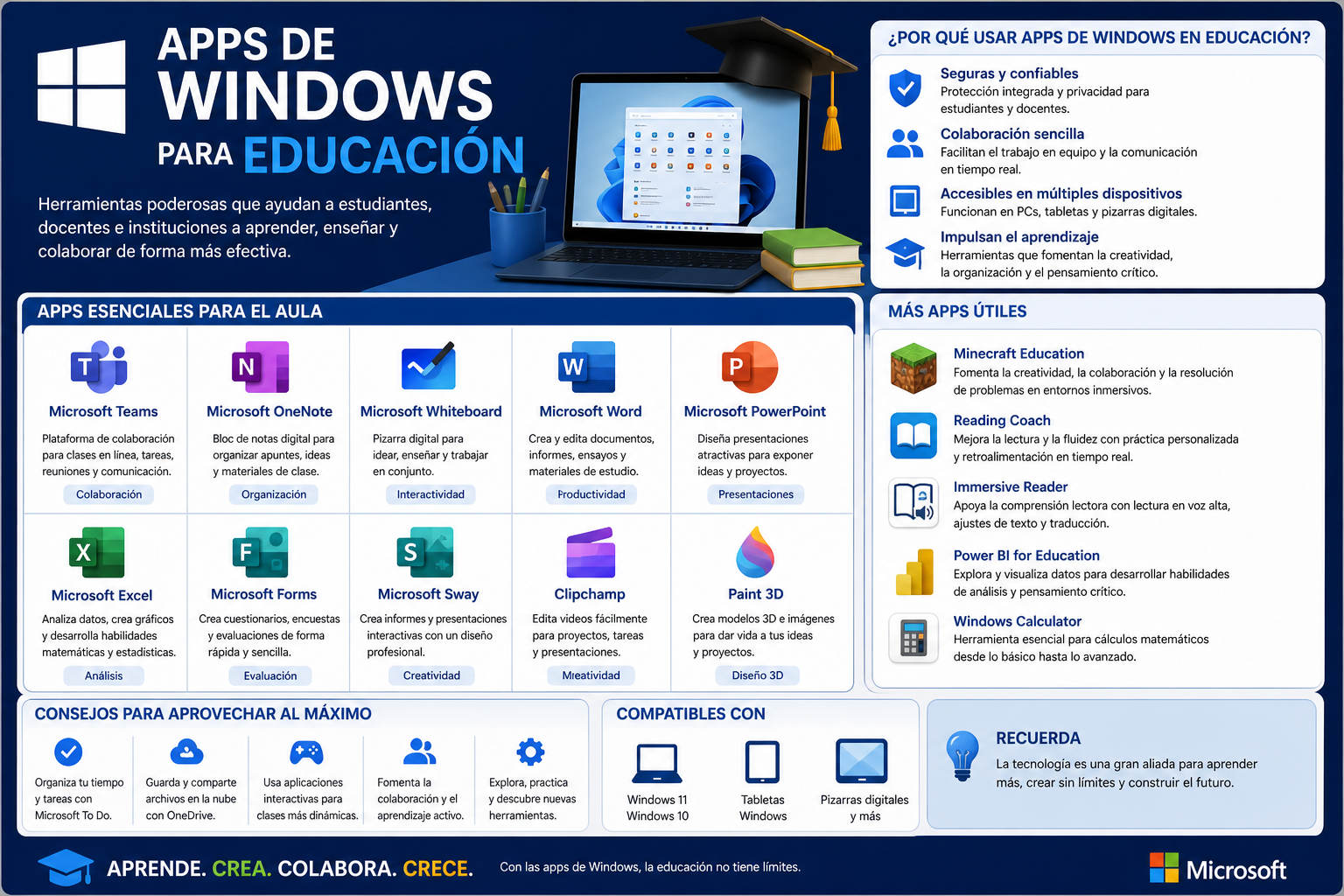
Today, learning and teaching with technology goes far beyond having a computer on the table. Windows, as the most popular operating system in the educational field, has a huge range of applications designed for teachers, students and all types of centers. The universe of educational apps on Windows continues to growFrom powerful suites for organization and online classes, to apps to improve concentration, creativity and make education fun, collaborative and tremendously flexible.
If you are a teacher, student, or educational manager looking for the best tools for your PC, this article provides a complete and updated overview of essential Windows apps for education in 2026. We have gathered the most recommended solutions for each profile and need, from collaborative platforms and classroom management to AI apps, gamification, planning, bibliography And more. All of this is analyzed in detail, describing its practical use, integration with other platforms, and added value for creating the best digital learning experience. Get ready to unlock the full educational potential of Windows, both inside and outside the classroom.
Overview of educational technology and its impact
The digitization of education is not the future: it is the present. The development of new solutions, the rise of distance education, and hybrid learning have multiplied the importance of digital tools for teachers and students. According to recent studies, the global market for educational software It already exceeds 450.000 billion dollarsAnd in this trend, Windows plays a key role thanks to its compatibility, stability, and robust application library.
What are users really looking for? Both teachers and students demand much more than a basic digital whiteboard: easy management of classes and schedules, effective communication, remote access to materials, AI integration, gamification, tutoring and personalization, collaborative document editing, multimedia resources, and the ability to carry all their educational work on any connected device. The range of apps on Windows has evolved, covering every need and driving innovation in the education sector.from primary school to university and professional training.
Advantages of using educational apps on Windows
- Full compatibility with the most commonly used tools: Microsoft Office, Google Workspace, Notion, OneNote, and more, are easily integrated.
- Cross-platform and synchronization: Most applications allow collaborative work and access to materials from any device.
- Data security and control: Windows solutions generally comply with regulatory requirements such as GDPR or FERPA, especially academic ones.
- Adaptability to different teaching and learning styles: From apps for gamification to advanced classroom management, including AI assistants that generate content or personalize learning.
Basic and essential apps in the digital classroom
Some applications set the standard and are indispensable in almost any educational environment. They not only help with management, but also enrich lessons, improve communication, and facilitate collaboration. Here are the most relevant ones and their specific uses in today's classroom.
- Microsoft Office Suite (Word, Excel, PowerPoint, OneNote and Teams): The leading office suite. It allows you to do everything from write papers, take notes, generate presentations Champagnes and Cavasspreadsheets for tracking assessments and integrating teams For chats, video calls, group management and collaborative work, now enhanced with Copilot (AI) integration directly into Windows.
- OneNote: One of the best tools for taking digital notes, mixing text, drawings, audio, web clippings and organization by notebooksPerfect for both classroom use and faculty meetings. Compatible with cross-platform synchronization.
- Khan Academy: learning platform free and multidisciplinary which has revolutionized the teaching of science, mathematics and history. Their Windows app provides access to thousands of videos, interactive exercises, and self-assessment tests.Perfect for review, reinforcement or self-study, from primary school to university.
- Google Classroom: Essential solution in centers with a Google ecosystem: Creates and distributes tasks, materials, and examsIt communicates new features and expresses appreciation for its ease of use and integration with Google DriveCalendar and other Google Workspace tools.
- Zoom and Microsoft Teams: For videoconferencing, tutoring, virtual classes, and remote collaboration. They allow screen sharing, session recording, breakout rooms, chats, and much moreMicrosoft Teams, in particular, is perfectly aligned with Windows and the Microsoft suite, and also features AI integration through Copilot.
- GeoGebra: The cross-platform software for visual and interactive mathematicsGraphics, algebra, calculus, and statistics in one free and highly versatile tool, ideal for both teaching concepts and allowing students to experiment independently.
- Duolingo : The world's most famous language appNow with features for classrooms and teachers. It gamifies learning, allows for continuous practice, and is useful from A1 to advanced levels. Its classroom mode facilitates assignments and monitoring by teachers.
- Quizlet: AI-powered flashcards, quizzes, and practice modesHighly recommended for memorizing vocabulary, dates, formulas, or any sequential content, with collaborative features and access to millions of sets created by other users.
- Kahoot!: Transform any review into a game or competitionIdeal for reviewing before exams, motivating participation, or conducting quick surveys. Perfect for both in-person and distance learning.
Innovative AI and automation apps for education
Artificial intelligence-based solutions are marking a turning point in digital education. Windows has integrated tools like Copilot directly into the operating system, allowing any teacher or student to access an AI assistant capable of summarizing, correcting, suggesting resources and offering instant support for tasks such as:
- Information search and organization: Capable of summarizing articles, suggesting sources, or reformulating content adapted to each educational level.
- Writing and editing support: Tools like Grammarly and Copilot help to write essays, polish grammatical errors, or adapt the tone of academic documents.
- Code development and technical explanations: With Copilot or ChatGPT you can get help with programming, resolve math and science questions, or ask for clarification on advanced features.
- Generation of educational resources: Canva, awesomely and other applications allow you to create presentations, infographics, educational videos and interactive content by integrating AI to quickly suggest designs and templates.
These AI functions allow for personalized learning, detection of gaps, and real-time adaptation to the needs of students and teachers.Furthermore, they make correction and feedback on assignments, exams, or projects much more agile and effective.
Apps for organization, time management, and academic planning
Success in digital education depends on the ability to organize all academic life efficiently. There are specific Windows solutions designed for students and teachers to organize classes, subjects, assignments, and meetings. Some of the most notable are:
- My Study Life: Excellent for manage schedules, exams, tasks, and reminders in a cross-platform application with a clear and intuitive interface.
- Trello: Popular in the organization of educational work using Kanban boards, ideal for group work, task distribution, project tracking and teacher coordination.
- Easy Study: Simple yet effective for planning study sessions, thematic blocks, and reviewing personalized goals. Perfect for students looking to manage their time.
- Goodnotes: Especially valued (although native to iPad) for creating digital notebooks, highlighting, making handwritten notes and organizing notes visually and flexibly.
- Forest and Focus To Do: Apps that employ smart concentration techniques. Forest uses gamification to increase productivity (planting trees if you maintain concentration) and Focus To Do helps implement the Pomodoro Technique to work in time blocks and improve focus.
Collaborative tools and group work applications
Collaboration is a fundamental part of modern learning. Windows seamlessly integrates group work solutions, from chat apps to complete collaborative editing platforms:
- Notion: An all-in-one workspace, ideal for creating databases, sharing notes, and organizing group tasks. Useful for both classroom projects and internal management within teaching teams.
- Microsoft Teams: It centralizes communication through chat, calls, video conferences and private groups, also integrating all Microsoft Office functions and parental controls if required.
- ONLYOFFICE Docs: A satisfactory solution open source for real-time editing and collaboration of documents, spreadsheets, and presentations. Integrates with Moodle and Nextcloud, widely used in universities and schools to ensure data control and secure work in demanding environments.
- Google Workspace: Although not exclusive to Windows, its suite allows you to work collaboratively on Drive, Docs, Sheets, and Slides from any connected Windows PC.
The key is in combine applications that allow you to edit documents, plan in groups, chat and make video calls According to the project, the goal is to create a digital ecosystem adapted to the needs of each center or subject.
Educational management software and LMS
In large schools and institutions, efficient management is essential. The LMS Learning Management Systems (LMS) in Windows allow comprehensive control of the classroom, materials, progress, and communication with families or students:
- Moodle: Possibly the most widespread and customizable LMS. Manage courses, groups, assessments, and progress trackingMultiplatform, secure and compatible with a wide ecosystem of plugins and specialized educational apps for Windows.
- Canvas, Schoology, Blackboard Learn: Business solutions seamlessly integrated into Windows through browsers or proprietary applications, adapted for primary, secondary and higher education, with advanced dashboards and regulatory compliance monitoring.
- OpenBoard and digital whiteboards: Open source tools to explain concepts visually and flexibly, both in face-to-face and distance learning classes.
- OpenSIS, Alma, Gibbon and Fedena: School and administrative management solutions for grades, attendance, enrollment and reports, essential for centers seeking to digitize processes securely and efficiently.
Apps for creating and editing educational content
Learning is more effective with engaging and personalized resources. Windows allows you to create and edit from conceptual maps including educational videos. The most recommended apps include:
- Canva: Intuitive tool for creating visual materials such as posters, presentations, infographics, concept maps or summaries, with templates for education and the option to add AI to create resources with just one prompt.
- Genially: Allows create dynamic presentations, interactive resources, and gamified activities easily from their website, with integration on Windows PCs to download resources and present them in class.
- Prezi: An alternative for non-linear presentations with amazing effects, using artificial intelligence (AI) to quickly and easily generate visually appealing content.
- OBStudio: Open-source video editor and live streaming tool, widely used for recording lessons, streaming classes, advanced editing of educational videos, and tutorials. Natively compatible with Windows.
- CapCut, Clipchamp, Descript: Multimedia editing applications, from trimming clips to adding automatic subtitles, AI effects, transcriptions, and audio and video optimizations.
- Drawboard PDF, Adobe Acrobat: Tools for reading and annotating PDFs, highlighting materials, inserting comments, and easily sharing resources. Essential for organizing digital documents in the classroom.
Apps for note-taking and academic information organization
Having information readily available is key in a digital learning environment. There are specific apps for note-taking, knowledge organization, and quick access to academic databases:
- Joplin: Open-source note-taking tool, Add images, videos, PDFs, and audio filesIt offers synchronization and maximum privacy.
- Obsidian: Local application for storing notes in text format, completely private, adaptable through hundreds of plugins and capable of creating personal wikis and knowledge maps.
- Evernote: Centralize notes, images, links, PDFs, and audio in one placeWith tags, folders, and advanced search, it's very practical for organizing multidisciplinary materials.
- Zotero and Cite this for me: Academic bibliography managersThey allow you to collect, cite, and organize hundreds of sources in various styles, from scientific articles to web resources.
- Docsity, Dialnet: Platforms for accessing notes, essays, and academic literature created and shared by students and universities, very appropriate for complementing official materials or finding inspiration for papers and projects.
Apps to improve concentration and digital well-being
The challenge of studying and teaching online is not limited to accessing information, but also to knowing how to manage attention and digital well-being. Windows offers apps focused on improving concentration, avoiding distractions, and creating healthy study habits:
- Forest App: Gamify concentration by growing a virtual forest during distraction-free periods. Very useful for both individual study sessions and group challenges.
- Flipd App: An alternative to Forest if you prefer to directly block apps unrelated to studying and monitor your effective study time.
- Focus To Do: It combines a Pomodoro timer with a to-do list, ideal for time management and productivity, especially useful for those preparing for competitive exams or for long-term projects.
Specialized software for teachers and classroom management
In addition to general apps, there are applications geared towards the specific tasks of teachers. Key tools include those for assistance, grading, progress tracking, and communication with families:
- Attendance: Digital student attendance and tracking list, with the ability to create work teams and customize schedules, synchronized in the cloud.
- Plickers and Socrative: Apps for continuous assessment using surveys, questionnaires and real-time data collection, both via mobile phone and on the classroom PC.
- TeacherKit: Widely used for internal organization, grade management, behavior observation, and quick communication with parents and students.
- ThinkUp, Edmodo, ClassDojo: Platforms to improve communication and group management, sending notifications, rewards and immediate feedback.
- Planboard: Tool for curriculum planning, resource organization, standards and alignment of educational objectives for each class or group.
Tools for bibliography, citation and plagiarism control
More and more centers and students are seeking to ensure rigor in research and the delivery of academic work. The following apps facilitate access to reliable sources, enable automatic citation, and help prevent plagiarism:
- Zotero: , compatible with Windows and with advanced filtering, exporting and project organization features.
- Cite this for me: Web platform for Generate citations in different formats (APA, MLA, Chicago…) quickly and easily.
- Plag.es: Detects plagiarism and compares texts with thousands of sources, ideal for quick validation of work.
- RAE and Fundéu: Official dictionary and linguistic queries for Spanish, essential for reviewing and fine-tuning academic texts.
Simulators, virtual laboratories, and apps for technical subjects
Practical teaching is also being digitized thanks to simulators and interactive resources. They stand out:
- PHET Simulators: Virtual laboratory created by the University of Colorado with resources for physics, chemistry, biology and mathematics, all in HTML5 compatible with any Windows browser.
- Scratch: Visual language to introduce students to programmingPerfect for primary and secondary school students, with the development of creative and motor skills.
- Book Creator: An app for students to create digital books by combining text, images, and multimedia, very useful in creative writing activities and interdisciplinary projects.
- NASA's Eyes: NASA's app for exploring space and simulating missions, ideal for motivating curiosity about science in an immersive way.
- TypinClub: Platform for learning to type through lessons, games and practice tests, with progress tracking and personalized challenges.
Applications focused on school management and administration
The proper functioning of an educational center depends on the correct control of data, attendance, enrollments, human and financial resources. Among the most used Windows apps in 2026 are:
- OpenSIS, Gibbon, Alma and Fedena: Modular and scalable school ERP packages to manage everything from assessment and attendance to accounting and regulatory compliance.
- Nextcloud and Rocket.Chat: Secure and open-source alternatives for document control, internal chat, and secure storage on private servers.
Best practices and criteria for choosing educational applications on Windows
It's not just about creating the most comprehensive list, but about selecting the apps that will truly add value to your educational environment.Here are some key criteria:
- Compatibility and adaptation: Choose apps that are compatible with your LMS, assessment systems, and that can be integrated into your current workflow.
- Privacy & Security: Prioritize solutions that comply with international standards and offer control over data and backups.
- Update and support: Check that the app development is active and has adequate technical support/documentation.
- Cost and license type: Many of the apps recommended here are free or open source. Evaluate whether you need premium features and compare them before investing in commercial versions.
- Interface and ease of use: Prioritize applications that are intuitive for users - teachers, students, and families - and that do not require a steep learning curve.
The revolution of AI-powered laptops for education
Windows laptops equipped with Copilot+ chips and NPU (neural processing unit) have changed the way we study and work. Brands like ASUS now offer devices that not only optimize performance and battery life, but also incorporate advanced artificial intelligence features to:
- More human video calls: AI-assisted focus correction, background blur, noise suppression, and eye contact.
- Automatic image and sound recognition and optimization even in adverse environments.
- Integrated access to Copilot anytime to generate, correct, or summarize information instantly.
Other resources and communities for teachers and students
- Education 3.0: Veteran blog with free resources for teachers, recommended apps, guides and news on teaching trends.
- Docsity, The Slides: Portals for exchanging notes, worksheets, printable sheets and supplementary materials for all stages.
- HIV: A community for creating and sharing educational resources, open courses and exercises.
A comprehensive guide to Google Drive: what it is, how it works, and how to get the most out of it