
- Khan Academy is a free, personalized educational platform for all ages.
- It offers courses in mathematics, science, economics, computing, and the humanities.
- It facilitates self-directed and classroom learning, with resources for teachers and families.
- Its flexible and free model democratizes access to quality education.
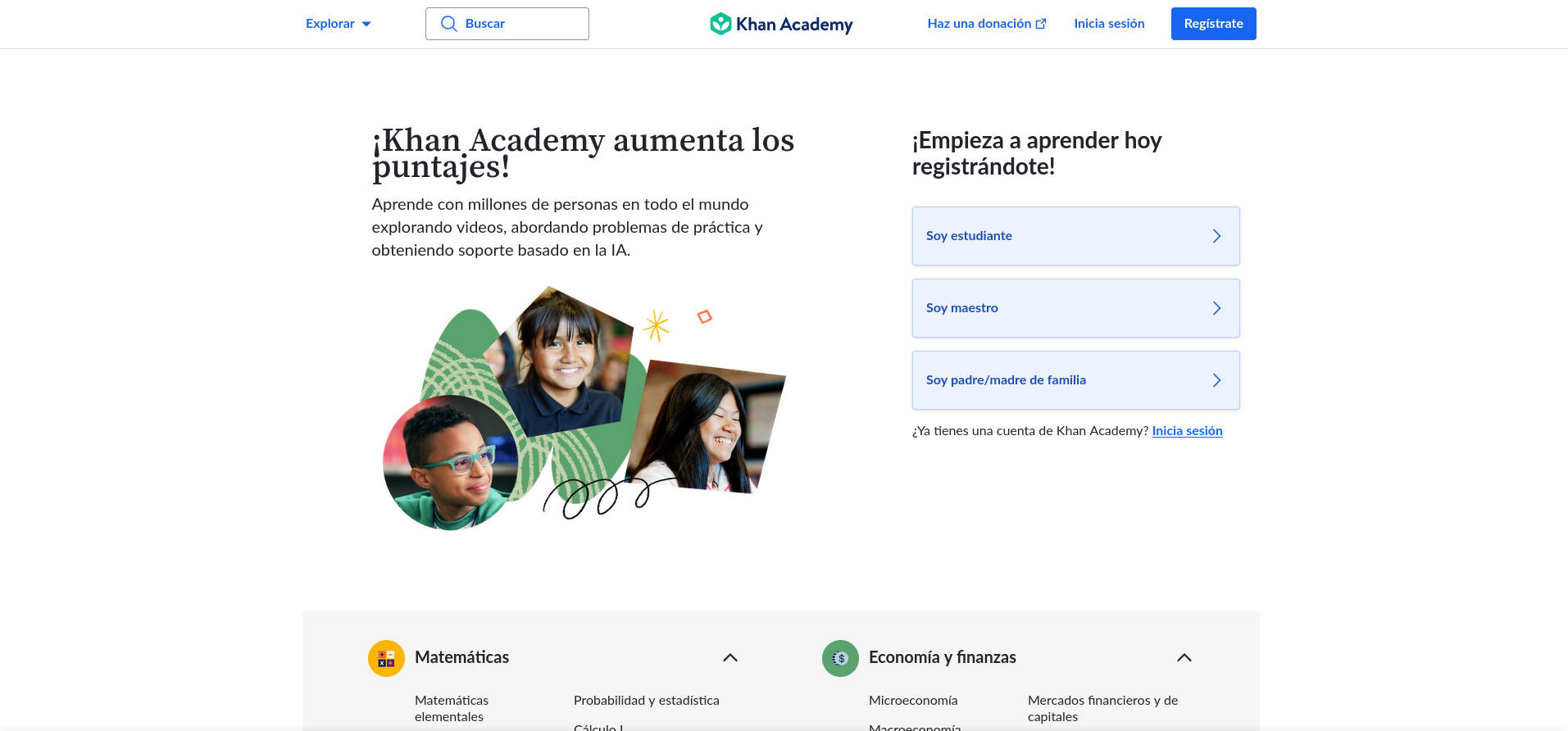
Khan Academy is much more than just an online educational platformSince its inception, it has positioned itself as one of the most revolutionary and accessible tools for students, teachers, and families, offering Free content adapted to all educational levelsToday, millions of people around the world use this platform to reinforce and expand their knowledge. If you've ever wondered what makes it unique, how it works, or whether it can truly make a difference in learning, stay tuned because here we'll tell you everything you need to know, integrating information from the most comprehensive and reliable sources.
Have you ever felt that math is a challenge for you, that you need more help in physics, or that there are history topics you'd like to review at your own pace? Khan Academy It was born precisely as a response to those needs: the possibility of offering quality education, without economic barriers, and completely tailored to the student. No matter your age, prior knowledge, or where you live; if you have the desire and an internet connection, you can start learning right now.
Origin of Khan Academy and educational vision
The history of Khan Academy It begins in 2004, when Salman KhanSalman, an American of Indian and Bangladeshi descent, began helping his cousin Nadia with math through short video lessons. What started as simple family support quickly evolved. Other friends and family members requested the same, so Salman decided to upload these videos to YouTube. YouTube so that they could access it anytime, anywhere.
The response was overwhelming. Soon, thousands of students and teachers began watching the videos, praising the clarity and usefulness of the explanations. Aware of the impact of his work, Salman left his career in the financial sector and dedicated himself wholeheartedly to developing an educational project with a very clear objective: democratize access to education and allow anyone to learn at your own paceThus was officially born the Khan Academy In 2008, it became a non-profit organization with the goal of bringing free, quality training to every corner of the world.
How does Khan Academy work? Platform and methodology
The key to Khan Academy's success lies in its flexible and personalized learning methodStudents will find thousands of explanatory videos, interactive exercises, assessment tests, and supplementary materials in a clean and organized interface. Each person can progress at their own pace, repeat lessons as many times as they like, and focus on what they really need to improve, without feeling pressured to keep up with the pace of a traditional class.
One of the platform's biggest advantages is that it is designed for both learning and personal development. autodidact as well as for classroom use. In fact, many teachers around the world have adopted the 'flipped classroom' model proposed by Salman Khan: students watch the videos at home and then, in class, practice, resolve doubts, and work in teams with direct support from the teachers. This method has been shown to improve comprehension and facilitate individualized progress.
Khan Academy offers courses in various languages, including Spanish.It doesn't matter if your goal is to improve your grades, reinforce concepts, prepare for an important exam, or simply learn for the pleasure of knowing.
Areas of knowledge: subjects and available content
The breadth of areas covered by Khan Academy is undoubtedly one of its greatest strengths. Among the subjects and topics available, you can find:
- MathsFrom basic arithmetic to algebra, geometry, trigonometry, calculus, statistics, probability, differential equations, and linear algebra.
- Economy and FinanceMicroeconomics, macroeconomics, financial and capital markets.
- SciencePhysics, chemistry, biology, medicine, cosmology, astronomy, and electrical engineering.
- Computers and TabletsProgramming, digital animation, computer science, and the hour of code.
- Arts and Humanities: World history, history of the United States, history of art, grammar.
The catalog is constantly growing, and in addition to the core courses, Khan Academy It offers preparation for standardized tests (such as the US SAT) and other additional content that can be very useful for both young students and adults.
Advantages of using Khan Academy
Numerous positive aspects have made Khan Academy It is a globally recognized tool for online education. Among its most attractive advantages are:
- Free and unlimited accessThe platform is completely free for all users. There are no hidden fees or premium subscriptions.
- Real personalization of learningStudents repeat, advance or delve deeper at their own pace, allowing each one to manage their learning process.
- Resources for teachers and familiesTeachers can create virtual classes, monitor student progress, and tailor support to the needs of each group or individual. Parents can also monitor their children's progress, fostering greater family involvement.
- Audiovisual material and interactive exercisesVideo explanations, practical activities, and tests allow you to check what you've learned instantly.
- Multilingualism and universal accessibilityIt has multilingual versions, including Spanish, making learning accessible to a much wider audience. All you need is an internet connection.
Use in the school and family environment
More and more schools and families are turning to Khan Academy as a complement to formal education or as the primary method of learning. It is especially useful for:
- Develop independent study habits in students who have difficulties in some subjects, allowing them to catch up and regain their confidence.
- Offer support and reinforcement according to levelssince the course programming is adapted to both primary school children and university students.
- Integrate family monitoringParents can create an account for their children and send them an invitation to link it to their own, making it possible for them to monitor the activity and progress of the childrenalthough without the possibility of establishing strict blocks or controls on which courses they can take.
There is a version for children under 8 years old. khan academy kidsThis version is designed exclusively for children. It features content specifically tailored for the youngest users, presented through interactive games and books guided by animal characters, facilitating motivation and early learning. Furthermore, this version includes some simple parental controls and a more visual experience.
Innovative pedagogical models
One of Khan Academy's most interesting contributions has been the introduction of innovative pedagogical approaches. Salman Khan proposed reversing the traditional teaching method Thanks to its 'flipped classroom' model, where theory is learned at home through videos and class time is dedicated to solving practical problems with the support of teachers and classmates, this methodology promotes understanding and individualized pacing, especially helping those who find the traditional approach difficult.
Furthermore, The platform allows for comprehensive tracking of each user's progress.Students have access to detailed statistics on videos viewed, exercises completed, points earned, and areas for improvement, regardless of whether they use their own account or connect it through social profiles like Google or Facebook. This information is key to personalizing their progress and reinforcing weak areas.
Global impact and institutional alliances
Since its creation, Khan Academy has transformed the way millions of people access knowledgeIt has established partnerships with educational institutions, ministries, and governments to expand its reach and actively participate in improving education in numerous communities. This collaboration has allowed for the adaptation of curriculum materials to local needs and amplified the positive impact in resource-poor areas. The organization maintains its commitment to free access and pedagogical independence thanks to donations and the support of various institutions.
Safety and supervision: protecting younger users
Safety is a key aspect, especially in environments with minors. Khan Academy offers tools so parents can monitor, though not restrictively control, their children's activity on the platform. Parents can create a parental account, invite their child's account, and, after acceptance, Check what courses you are taking and how much time you dedicate to studying.If the user is very young, it is always recommended to opt for Khan Academy Kids, which restricts access to the general community and adds additional controls designed for children.
The platform is especially useful for preventing educational errors; for example, if a young child accidentally enrolls in a university economics course, parents are notified and can intervene in time. Parental controls also allow for customization of the user experience with visual adjustments and seasonal themes in the Kids version.
Khan Academy versus other platforms: competitive advantages
There are several alternatives on the market, but Khan Academy stands out for its completely free access, its inclusive vision, and the enormous variety of resources.Unlike other tools that require a subscription or are geared towards very specific niches, here any user can find quality content to learn whatever they want at no cost and without annoying ads.
Some people may wonder if Khan Academy is worth using compared to other recommended options, such as IXL or other digital platforms. Experiences shared by students show that following algebra, geometry, and core math courses on Khan Academy has allowed them to get back on track, make progress in their studies, overcome academic slumps, and, above all, to demonstrate that everyone can learn and improve if you have access to the right tools and adopt a proactive attitude towards learning.
Who is Khan Academy useful for?
Khan Academy has proven useful for:
- Students of all ages, from primary school to university, who wish to reinforce subjects or improve their results.
- Adults who want to refresh their skills, learn new disciplines from scratch, or review forgotten concepts.
- Teachers and tutors seeking tools to enrich their classes and monitor the development of their students, facilitating more individualized attention.
- Families who wish to be involved in their children's learning, especially if they face difficulties or wish to broaden their educational horizons.
User testimonials confirm that Khan Academy is not only useful for passing exams, but also for cultivating self-love towards knowledge, combating the idea that 'I'm not good enough for this' and discovering new passions.
Entry requirements and steps to get started
Getting started with Khan Academy is really easy: all you need is a device with internet access. Registration is optional, but if you create an account (using email, Google, or Facebook), you can save your progress, get personalized recommendations, and access comprehensive statistics about your achievements.
For the little ones, the app khan academy kids It can be installed on both mobile phones and tablets and guarantees a fun and safe environment. Meanwhile, the main website allows users to explore hundreds of courses and resources from elementary school to university levels.
Edpuzzle: All about the tool that is revolutionizing educational videos