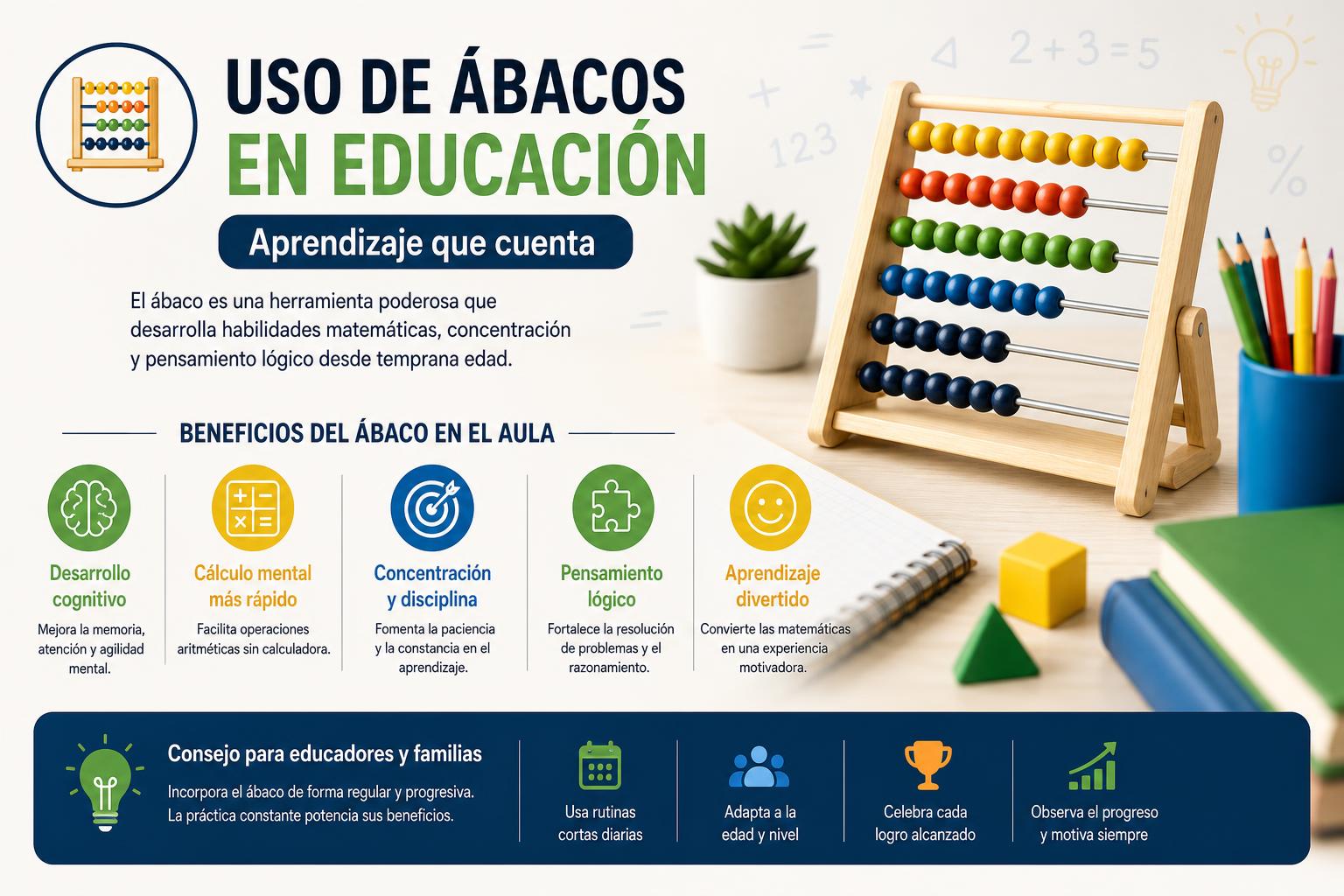
- The abacus remains relevant in modern education due to its many cognitive and mathematical benefits.
- Its use promotes understanding of the decimal system, mental calculation, and visual memory.
- There are various types of abacus (Japanese, Chinese, school) adapted to different educational levels.
- Programs and centers in Spain demonstrate their effectiveness in improving mathematical competence and attention.
The abacus, that ancient instrument that has accompanied humanity for centuries, has once again earned a place in modern classrooms and educational methodologies. In the digital age, where electronic devices and educational apps dominate, it is surprising that such a simple and classic resource is regaining popularity and interest among teachers, families, and educators.
Why has the abacus remained relevant and, above all, why is its use increasing in education today? Throughout this article, we will delve into the role of the abacus in children's mathematical education, its origins, benefits, types, practical applications, and its proven impact on learning. You will discover how using the abacus can be key for students to develop solid mathematical skills and cognitive abilities that go far beyond traditional arithmetic operations.
History and evolution of the abacus in education
The abacus is considered one of the oldest known calculating instruments, with origins that can be traced back to antiquity in regions such as Mesopotamia, China, Greece, and Rome. For example, in ancient Greece, the marble tablet 'abakion' was used, while the Romans had their bronze version that allowed for the movement of stones to perform addition and subtraction. Over time, different cultures adapted this tool, transforming it into what we recognize today as the classic abacus, present in various forms: the Chinese, the Japanese—known as the soroban—and other forms used throughout the world.
In Europe, the abacus was fundamental for centuries in trade and primary education , although it almost disappeared after the introduction of the Arabic numeral system and the popularization of written arithmetic. However, it never completely disappeared in places like Asia, where it remains relevant both in everyday life and in specialized educational programs. Today, the abacus is once again valued as a highly effective pedagogical tool for introducing students to basic mathematical concepts and improving their cognitive skills.
What is an abacus and what is it made of?
The traditional abacus consists of a rigid frame into which several rods or strings are inserted in parallel, onto which movable beads or balls are strung. The structure can vary, but typically each rod represents a place value in the decimal system (units, tens, hundreds, etc.) and each bead, a corresponding number. The movement of the beads signifies a specific addition or subtraction, thus facilitating a tangible understanding of the positional system and the value of numbers according to their position.
There are several types of abacus , each with its own particularities and educational applications:
- Japanese abacus (Soroban): It is distinguished by having four beads on the bottom of each rod and one more on the top, which promotes speed in mental calculation.
- Chinese abacus (Suanpan): It has five beads per rod in the lower zone and two in the upper zone, being used both in traditional teaching and in advanced calculation programs.
- Horizontal and vertical abacus: The horizontal one usually has ten horizontal rods (each one represents a ten), while the vertical one, very widespread in classrooms, facilitates the manipulation of the beads to represent different quantities.
- Ten-bead or school abacus: It is the most common model in educational centers, ideal for introducing the decimal system.
Access to abacuses is no longer exclusive to experts or mathematics teachers ; today they can be easily purchased in physical or virtual stores dedicated to educational materials, as well as in toy stores, which facilitates their implementation in any educational center or even at home.
Benefits of using the abacus in early childhood and primary education
The main educational value of the abacus lies in its ability to make abstract mathematical concepts tangible and develop transversal cognitive skills. Numerous studies have supported its effectiveness, highlighting the following benefits in particular:
- Improves understanding of the positional system: Manipulating beads and rods helps students to clearly and concretely understand the value of each digit according to its position within a number.
- Encourage mental calculation: Through practice with the abacus, children develop mental agility and flexibility in operations of addition, subtraction, decomposition and composition of numbers.
- Develops global cognitive skills: The abacus enhances concentration, visual memory, mindfulness, and logical reasoning skills.
- Promotes fine motor coordination: The simple act of manipulating different beads on the abacus strengthens manual dexterity and hand-eye coordination, essential skills in early childhood.
- Promotes balance between both brain hemispheres: By working on both numerical logic (left hemisphere) and visualization and creativity (right), the abacus offers a complete and integrative experience.
- It contributes to the development of mathematical thinking: Practicing with an abacus allows you to acquire concepts such as all/nothing, left/right, combination, equivalence, magnitude and proportion.
Experts and specialized programs, such as those from UCMAS Spain and Educación 3.0 , have confirmed that the continued use of the abacus has a significant impact on skills such as creativity, selective attention, photographic memory, and sustained concentration. Furthermore, activities and workshops have been implemented in various Spanish schools, including the Paco Rabal Public School in Guadalajara, the Santa Ana School, and the KidsBrain program, which is present in hundreds of schools.
From what age is it appropriate to introduce the abacus?
The introduction to the use of the abacus can take place in Early Childhood Education , always from a playful perspective, using the abacus as an instrument to experiment, play with concepts of quantity, all/nothing, colors, right/left, and to visually associate the first numbers.
However, it is in the Primary Education stage —from 6-7 years old— when the abacus reveals its full potential , since it is at that age that children make the leap to the decimal number system and face the first mathematical operations with a higher level of abstraction.
Practical applications and educational activities with abacuses
The abacus is not just a tool for learning addition and subtraction . It has become a multidisciplinary resource for a multitude of practical activities, all aimed at consolidating the learning of mathematical concepts and enhancing cognitive and motor skills.
Main educational uses
- Understanding the decimal system and place value: The position of a bead on a particular rod allows us to tangibly show how the same number varies depending on where it is placed, which is essential for understanding numerical magnitude.
- Decompose and compose numbers: By playing with the abacus, children can physically see how a number is formed by grouping units into tens, hundreds, etc.
- Perform basic operations: It allows you to practice addition and subtraction in an intuitive and visual way, and at more advanced levels, multiplication and division.
- Representing mental calculation processes: As you become more proficient, the abacus becomes a support for mental calculation and problem-solving more effectively.
- Displaying decimal numbers and getting started in combinatorics: The resource is also used to practice equivalencies, divisions, and small combinatorics exercises through the manipulation of the accounts.
Practical examples of activities with abacuses in the classroom
- Representing numbers on the abacus: The teacher asks the students to form, for example, the number 57: seven beads in the units row and five in the tens row. Dice, bingo balls, or other materials can be used to add variety and encourage play.
- Recognizing pre-formed numbers: Students observe a representation with the abacus and must write the number they see, or vice versa: they hear a number and represent it by moving the necessary beads.
- Identify the number before or after a given number: Very useful for reinforcing the sense of order and quantity, as well as working with the concepts of "more than", "less than", or understanding the difference when modifying positions and values.
- Decompose numbers into addends: For example, students can be asked to create different ways to decompose 10 using numbers, thus developing an understanding of addition and subtraction.
- Playful applications: You can play 'number bingo' using the abacus to represent the winning numbers, or even pose small challenges of calculation speed and memory.
Research and studies on the educational impact of the abacus
The effectiveness of the abacus in improving mathematical skills has been supported by several well-known studies. For example, the work of researcher K. Vasuki, entitled "Impact of Learning Mental Arithmetic with an Abacus on Children's Cognitive Abilities," has shown how students who work systematically with the abacus develop attention, cognitive flexibility, mental calculation, and visual memory more quickly compared to those who use traditional methods.
In Spain, various universities and public centers have also carried out comparative studies between students who use an abacus and those who do not, finding notable differences in the development of observation skills, concentration ability and problem-solving skills.