
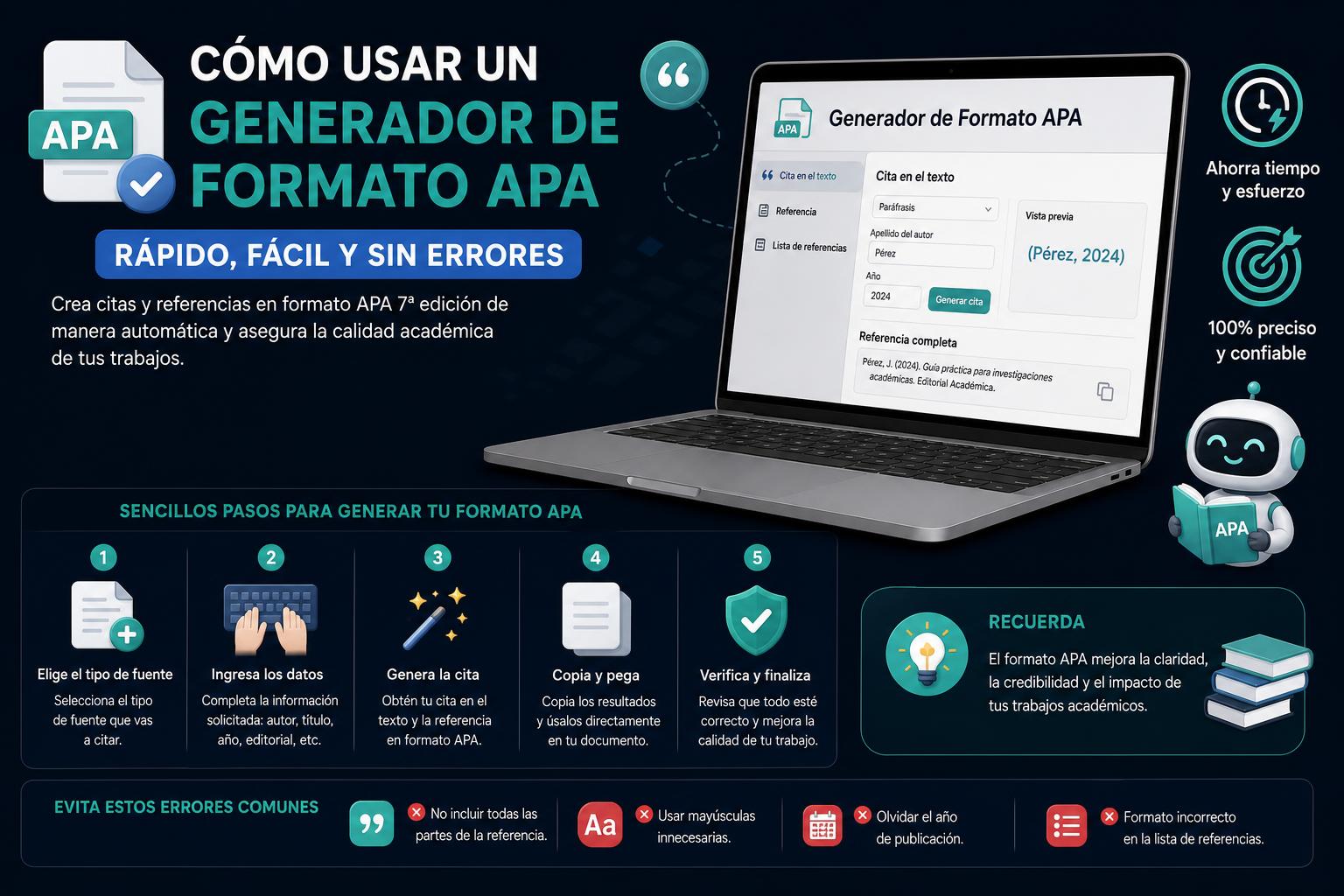
- A complete breakdown of the best tools for creating APA citations and references online, with a focus on the 7th edition.
- Comparison of advantages, limitations and examples of use of each currently available automatic generator
- Key differences between APA 6 and APA 7 versions, and tips for adapting citations to each institutional requirement
The APA format has become the essential standard for anyone entering academia, whether in the social sciences or research fields. If you've ever been frustrated by the task of creating references, you're not alone! Fortunately, today there's a wide variety of automatic APA citation and reference generators that promise to save time and prevent errors that can cost you points on papers or assignments. However, not all generators offer the same features, and they aren't all equally accurate or comprehensive.
In this article, I bring you a complete and up-to-date guide to all the leading options currently available online for creating APA citations and references, covering both the seventh edition (the most recent) and previous versions. I'll also provide tips for using them correctly, highlight the most relevant differences between versions, and offer honest comparisons to help you choose the right tool for your needs. Get your pen and paper ready, because after reading this, you'll have a comprehensive overview that you won't find on a single website.
Why use APA format and when is it mandatory?
The APA style , created by the American Psychological Association, is one of the most widely used in academic writing worldwide, especially in fields such as psychology, education, and the social and behavioral sciences . The main objective of APA format is to standardize how references and citations are presented, so that any reader can quickly access the original source and assess the validity of the presented data. When writing an academic paper, scientific article, undergraduate thesis, master's thesis, or doctoral dissertation (or even publications in international journals), you will most likely need to follow this standard precisely.
Proper APA citation is not just a matter of protocol; it is essential for several reasons:
- You acknowledge authorship and avoid plagiarism: You show that you respect the previous work of other researchers.
- You strengthen your argumentsA work well supported by sources carries more academic weight.
- You facilitate the consultation and verification of dataYour readers can easily go to the source if they need to verify something.
You must cite every time you take data, ideas, or arguments from another author , except when it is public information or common knowledge.
What exactly is APA format?
APA style is a fairly detailed set of rules that govern in-text citations, endnotes, and general formatting aspects such as font, spacing, margins, and the structure of headings and tables. Its main feature is the author-date citation : the author's last name and the year of publication are placed in parentheses within the text, for example (Pérez, 2021) . There are significant differences between the various editions, with the seventh edition (2020) being the most up-to-date and internationally used today.
Why do you need an APA format generator?
Mastering APA style requires paying close attention to very specific rules regarding punctuation, italics, author order, and special structures depending on the source type . Errors are common (especially in details like DOIs, URLs, omissions of authors or dates), and the style guide is updated periodically. Automatic APA generators have emerged to make life much easier for students, researchers, and professors by generating accurate citations in seconds. But not all are created equal: some specialize in APA 6th edition, others in APA 7th edition, and still others offer comparisons, additional help, and even error checking or integration with real scientific databases.
Comparative guide: the best updated APA format generators
Here's a rundown of the top-ranking online APA format generators currently available. I've analyzed their strengths, their unique features, and how they can be tailored to your specific needs.
1. Scribbr: Automatic APA Generator and Step-by-Step Guide
Scribbr stands out as one of the most comprehensive resources for those seeking academic rigor and ease of use. Its APA format generator allows you to automatically create both in-text citations and full references, always free and updated according to the seventh edition . Furthermore, its explanatory guide accompanies each section of the style guide and focuses on details such as:
- Differences between parenthetical citation and narrative, with modeled examples.
- How to cite sources with multiple authors or organizations, with comparative tables.
- What to do if some key information is missing (author, date, page number, etc.).
- Clear examples for each situation explaining the nuances of punctuation.
- Specific formatting guidelines for the references page: alphabetical order, line spacing, font type, indentation, and page numbering.
Without a doubt, it is a recommended resource for beginners and for those seeking maximum precision.
2. BibGuru: schedule, organize and persuade
This APA citation generator emphasizes the importance of citing sources to validate any academic document. Its central argument is that citing is not just about complying with the rules, but also about building a solid argument by demonstrating that the author has used reliable sources. Among its most useful features are:
- Explain clearly Why, when, and what should you cite? in a job, helping even those who are just starting out in research.
- It makes it easier to choose how many sources to cite depending on the type of work (for example, in review essays a much longer list is expected).
A tool designed to save time and learn the fundamentals quickly.
3. MyBib: a practical generator with real references
MyBib goes far beyond basic generators. It offers real-world examples of APA references and allows you to enter URLs, PDF addresses, and search for resources to convert into ready-to-copy/paste citations. Its main strengths are:
- It includes examples taken directly from scientific literature, with accurate formats and real DOIs.
- It allows compiling a complete list of references effortless.
- Compatible with websites, books, articles, wikis, etc.
It is one of the favorite options for those who want to see exactly how their bibliography should look , as well as practice with real references.
4. HazMiTrabajo: a comparison of the best APA generators
Those who prefer a broad overview and comparing different services will appreciate resources like those offered by HazMiTrabajo.es. This blog compiles the main job generators on the market, describing their advantages, limitations, and the type of user they target. Some of the projects they've analyzed that deserve mention are:
- Citethisforme: Very popular, with a Chrome extension and multilingual (visit Citethisforme).
- BibMe: Simple interface, spell check and variety of document types (See BibMe).
- Citation MachineIt provides tools to avoid plagiarism and spelling errors, and a database of millions of texts (More from Citation Machine).
- EasyBibSimilar to Citation Machine, with automated tools and a free version (go to EasyBib).
- Bibliographic ReferencesIn addition to an APA generator, it covers Vancouver and offers practical guides (Link to Bibliographic References).
- KnightCiteSuitable for APA, MLA and Chicago, no registration required, ideal for speed citations.
- eTurabian: Focused on the Turabian format but with an option for APA, although it works with the 6th edition.
- Word APA GeneratorIntegrated into Microsoft Word, useful for basic daily work.
The main contribution of this website is to help you select the tool that best suits your needs, depending on the type of source or the work to be presented.
5. APA.org.es: Accuracy and adaptability for the 7th edition
At APA.org.es you'll find an updated generator for the seventh edition , designed for students, professionals, and teachers to quickly generate accurate citations . Key features include:
- An simple interface and straightforward: perfect for users with little technical experience.
- They emphasize the absolute precision and strict compliance with all the latest APA guidelines.
- They support the generation of references for a wide variety of sources (books, articles, websites, etc.).
- FAQ and additional resources to answer frequently asked questions and explain the logic behind the rules.
A recommended choice for those seeking the best balance between speed and accuracy in references.
6. Grafiati: specialized generator for APA editions
While most generators now focus on the seventh edition, Grafiati keeps both versions updated, offering support for both APA 7 and APA 6. This distinction is crucial since there are still universities, journals, and papers that require the older version. Its most interesting features include:
- Automatic conversion between APA 6 and APA 7, or from/to other styles.
- Full control over the specific details of each edition (especially the order and form of citations and references).
- Ideal for work that needs to be sent to different institutions with special requirements.
Its usefulness skyrockets for academics with adaptation needs and international publications.
7. CiteMe: Verified citations from real databases
CiteMe takes automation a step further: it connects directly to academic databases (OpenAlex, CrossRef, Semantic Scholar, PubMed, etc.) to retrieve the correct metadata and generate a perfect reference, adhering to the 7th edition of APA style . Its main advantages include:
- You can search by URL, DOI, ISBN or subject and retrieves all relevant data.
- Include the validated DOI when available, a detail that juries and journals greatly appreciate.
- It works for books, magazine articles, websites, videos, PDFs, and much more.
- The free option is complete and sufficient for most cases; if you need intensive use, there is a Pro plan.
Highly recommended if you are looking to avoid human error and need guarantees of maximum accuracy in bibliographic information.
Key points on using and selecting an APA generator
- The generator must be up to date.Always check that it follows the 7th edition (APA 7) if that's what your institution or journal requires. Some still only use APA 6, which might not be valid. Tools like [tool name] or [tool name] excel in this regard.
- The data source is essentialIf possible, choose generators that obtain metadata from scientific databases and not just from what the user enters manually (as in the case of CiteMe).
- Always double-check the appointment before submitting your workAlthough automation saves a lot of time, no tool is infallible; check punctuation, italics, and the order of elements.
- Take advantage of the resources and additional helpWebsites with comparisons, guides, and practical examples, such as those provided by Scribbr or HazMiTrabajo, will allow you to learn and refine your judgment.
For those who need to work efficiently and professionally on academic papers, online APA generators have revolutionized citation creation . Considering the nuances between versions, the wide range of resources offered, and support for different font types, choosing the right generator can make your life easier and help you save time and improve the accuracy of every university or academic assignment. Take a few minutes to explore several of these options and discover which one best suits your needs, but remember that, ultimately, the final review and responsibility are yours. Dare to simplify your academic life by using the right tool from the start!
The definitive guide to bibliography management: methods, tools and practical tricks