
School bullying threatens almost 2% of Spanish children

The fact that schools are appearing more often in the crime pages of newspapers than in the education and culture section is causing serious concern among all members of the educational community. Indeed, episodes of violence in schools seem to have a great capacity to attract public attention, causing widespread alarm.
The tragic incident involving Jokin, a 14-year-old secondary school student who jumped from the wall of a town in Gipuzkoa after being cornered, has brought to the forefront the need to prevent and avoid violence in schools. In this case, a group of peers, specifically another group of students who mocked him and literally made his life "a living hell," ended his life without anyone being able to stop it.
His suicide has, in some way, made us all carry out a painful examination of conscience regarding a phenomenon that is not new, and that many of our students have been suffering from for many years, and which deserves collective reflection and an urgent anti-bullying educational program.

It's clear that teachers are key to change. If we can raise awareness among our teachers about the harmful effects of bullying, future generations of children and parents will, in turn, be made aware of it. Today's child is tomorrow's parent, and with the right training, we can all achieve a society where bullying becomes the exception.
Therefore, we hope this information will be as useful and enriching as possible for everyone.
[youtube]http://www.youtube.com/watch?v=BkxpyX0iQm8[/youtube]
Maria, 14 years old. Victim of bullying.
This is something a 14-year-old girl wrote. It's just one example. Like her, thousands of children in this society suffer from what some call "just kids being kids." She expresses better than anyone what it feels like when one of our children is a victim of bullying, of school harassment.
ISuckers are the norm; they stalk you, they threaten you. They're going to insult me outside my house. They pushed me, two of them grabbed me. At first, I didn't say anything; they took my shoes, threw them away, my backpack. They asked me for a roll of cocaine, and I said no. Once inside Nel and another guy tried to pull my pants down on the bus. The driver didn't care. I was terrified. I told my mother. She keeps saying, "I'm going to ruin your life, I'm going to kill you." I ignore it, I try to act like it doesn't bother me. I stopped taking the bus. Every night I think about what he'll do to me tomorrow. It's humiliating. People won't take my side because they're afraid. One day he threw a dead pigeon and dog poop at me. And stones, lots of them. I really wanted to "disappear" because I couldn't take it anymore. Seriously. I didn't see any other way out. Everything is piling up. This and my grades are the biggest worries in my life. I have a 5% chance that I won't have to suffer anymore, because it's worse than cancer, and that I'll pass next year, that I'll pull through, and that that smile will come back to me, so I can be happy again and focus on the good things in life instead of the bad.
For all the Marias to regain their smiles, it is absolutely essential that everyone—parents, educators, and the entire society—is informed.

What is school bullying?
When we talk about “school bullying” we are referring to situations in which one or more students harass and intimidate another student —the victim— through insults, rumors, humiliation, social isolation, name-calling, physical aggression, threats and coercion… which can develop over months and even years, with devastating consequences, especially for the victim but also for bystanders and the aggressor himself.
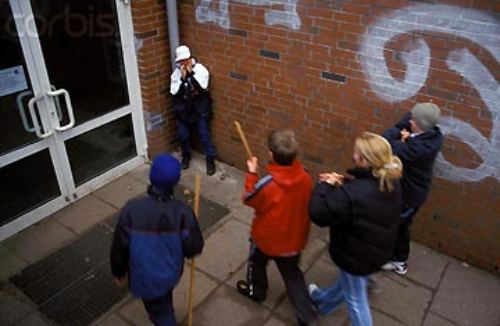
To refer to these situations of harassment, intimidation, and victimization among peers, the English term "bullying" is frequently found in the specialized literature. Therefore, we are referring to the same thing when we talk about school bullying, peer abuse, or "bullying."
The first to define this phenomenon was Dan Olweus, a professor of psychology at the University of Bergen (Norway, 1998), for whom victimization, or "peer abuse," is a pattern of physical and/or psychological harassment perpetrated by one student against another, whom they choose as the victim of repeated attacks. This negative and intentional action places the victims in positions from which they can hardly escape on their own. The continuation of these "relationships" has clearly negative effects on the victims: decreased self-esteem, anxiety, and even depression, which hinders their integration into the school environment and the normal development of their learning.

Situations in which one student teases another in a friendly way or as a game cannot be classified as bullying. Nor can it be classified as bullying when two students of the same grade level argue, have a dispute, or fight. Elements present in bullying:
- Initial obsessive and uninhibited desire to inflict harm, directed against someone defenseless.
- The desire materializes into an action. Someone is harmed. The intensity and severity of the harm depend on the vulnerability of the people involved.
- Abuse is directed against someone less powerful, either because there is physical or psychological inequality between victims and perpetrators, or because the latter act as a group.
- Abuse is unjustifiable. It occurs repeatedly. This expectation of endless repetition on the part of the victim is what gives it its oppressive and terrifying nature.
- It occurs with obvious pleasure. The aggressor enjoys the submission of the weaker person.
Sources:
- BULLYING SCHOOL HARASSMENT – GUIDE TO UNDERSTANDING AND PREVENTING THE PHENOMENON OF VIOLENCE. SERRATE, ROSA
- No to school bullying! Duval, Stéphanie
- http://www.psicologoinfantil.com
- http://www.acosomoral.org/pdf/guia_acoso.pdf