
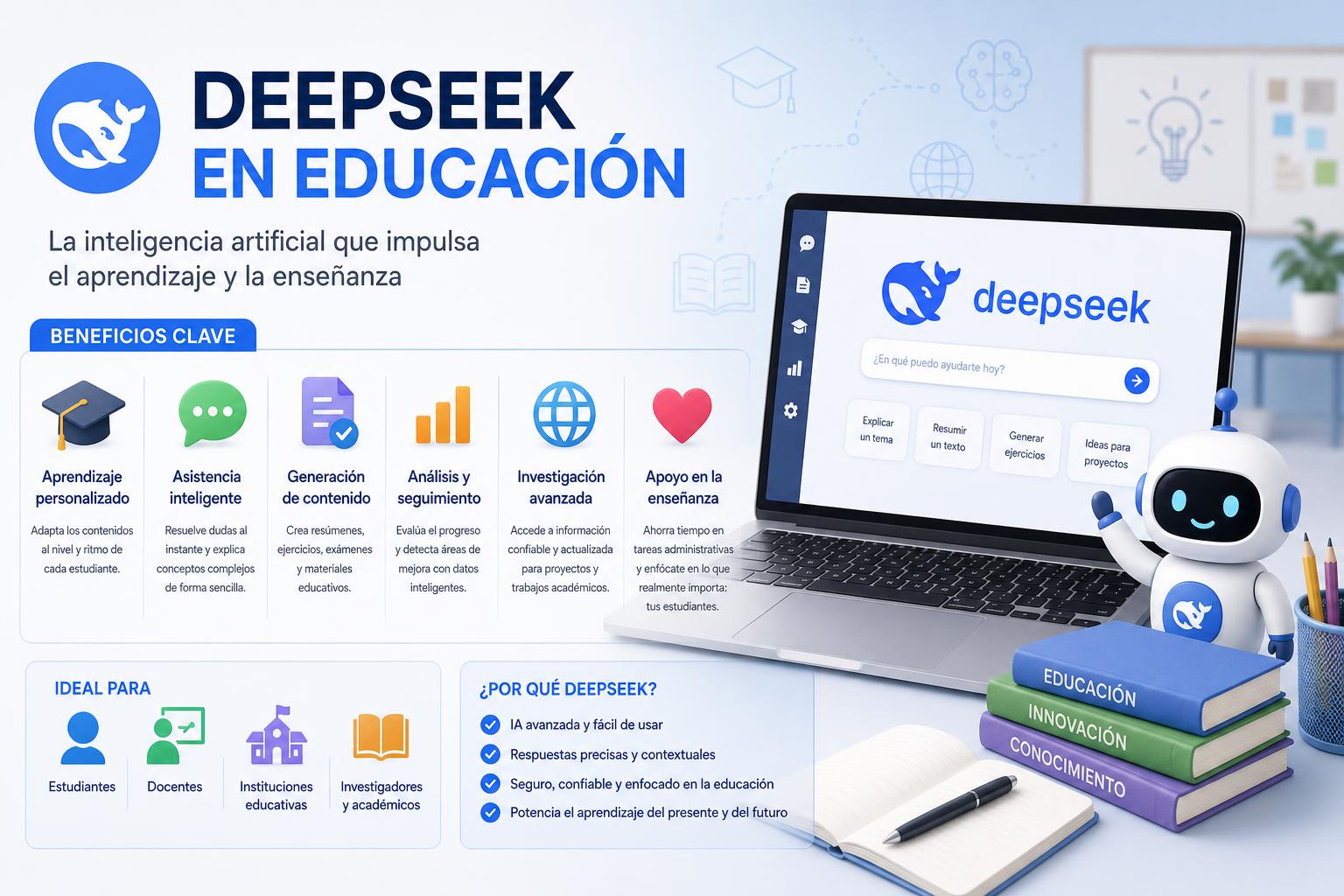
- DeepSeek stands out for its ability to create and run interactive educational mini-applications in HTML and its free access without the need for subscription or registration, facilitating digital inclusivity.
- This AI model of Chinese origin has shown competitive results against international solutions, especially in the automatic correction of technical tests and personalization of learning, being robust and flexible in its educational approach.
- The integration of DeepSeek into educational environments, including content creation, automated assessment, and teacher support, opens the door to a more dynamic, adaptive, and efficient education.
Imagine being able to create your own educational applications without any programming knowledge, directly through a conversation with artificial intelligence? DeepSeek is here to revolutionize the world of education, offering new ways not only to learn but also to design tailored resources for your students, saving time and unlocking teacher creativity . If you're looking for a versatile, accessible tool that goes beyond traditional chatbots, you've come to the right place to discover everything about DeepSeek in education.
In recent months, tools like DeepSeek have accelerated the integration of artificial intelligence into daily classroom life, from content personalization to assessment automation . But what makes DeepSeek different? Let's break down how it works, what you can actually use it for, how it compares to industry giants like ChatGPT, and the practical keys to leveraging it as a teacher or educational institution.
What is DeepSeek and how has it become involved in education?
DeepSeek is a conversational artificial intelligence model created in China in 2023 by Liang Wenfeng and developed by DeepSeek AI . Although competition in the AI field is fierce globally, DeepSeek has garnered attention thanks to its open-source approach , remarkable efficiency in language processing , and, above all, its ability to be quickly integrated into educational projects through services like DeepSeek ES or INTEF for Spanish-speaking teachers.
It is specifically designed to facilitate complex tasks such as text generation, problem-solving, document analysis, and the creation of simple interactive applications, all free of charge and without registration. This is a key aspect in the educational field, as it eliminates many barriers to access (essential in public schools and for minors aged 14 and over, who can use DeepSeek under supervision).
Linux Schools: The ultimate educational distribution for the classroom
Strengths and weaknesses of DeepSeek in educational settings
The documentation and tests conducted on various blogs and official education sector bodies (such as Bilateria ) have clearly defined the system's main strengths and limitations compared to other commercial AI systems like ChatGPT . Here is a summary based on all the analyzed content:
- No subscription required: Unlike other paid or feature-limited alternatives, DeepSeek is completely free, making it noteworthy for teachers and students.
- Analyzes text and allows document uploads: You can submit plain text files and request analyses or summaries, without needing to copy and paste large blocks.
- Generates and executes HTML code in real time: This means that, with simple instructions, you can have a mini-app to practice math, physics, languages… and see how it works directly without leaving the chat!
- Show the chain of reasoning: You can see, step by step, how the AI arrives at its conclusions and answers, which adds transparency and pedagogical potentialespecially for science or logic subjects.
- Excellent for mathematical and scientific formulas: DeepSeek represents complex formulas and equations in a appropriate visual format, fundamental for technical subjects.
- Internet access to verify data: It has the ability to search for up-to-date and relevant information.
- DeepThink mode for increased power: This option allows you to activate a more advanced model (similar to ChatGPT-o1) that can handle more complex tasks.
- Recommended minimum age: 14 years This makes it suitable for secondary and higher levels, although supervision is necessary at younger ages or in basic education contexts.
Regarding its most relevant limitations :
- It has no generation or interpretation of images: It cannot create illustrations, nor read images from PDFs, which limits its use for visual resources.
- It does not execute code or perform exact mathematical calculations: DeepSeek can display formulas but does not perform calculations programmatically like an advanced calculator or mathematical software would.
- The length of the conversation is limited: Each chat can handle up to a few 16.000 wordsIf you succeed, you have to copy the last code or generation, open a new chat and continue there.
- Limited complexity in applications: Ideal for mini-programs, but not for large integrated projects; it is recommended to segment complex tasks.
DeepSeek compared to ChatGPT and other leading AIs in educational assessment
One of the hottest debates in the education sector is the extent to which AI can replace, improve, or support teachers in the automatic grading of assignments and the design of technical tests . Recent studies, such as those presented at international conferences ( INNTED ), have compared DeepSeek with ChatGPT (specifically GPT-4) in the task of grading university programming exercises. The conclusions, clearly summarized, are very revealing:
- DeepSeek R1 matched the professor's rating in more than 39% of cases, far exceeding ChatGPT-4's 25%.
- The robustness and flexibility in the application of the correction criteria was greater in DeepSeekwhile ChatGPT tended to be stricter with minor but subtle errors.
- Both systems still fall short of human pedagogical judgment (especially in valuing creative or unconventional solutions), but DeepSeek emerged as the most technically sound and consistent..
- The recommendation is to combine AI with human supervision for the time being to avoid automation or unfair decisions.
In addition to programming, experiences like those at UNED have also demonstrated that DeepSeek is capable of competing head-to-head with ChatGPT in solving multiple-choice exams in subjects such as Legal Theory (according to results from Docta UCM ). Both AIs obtained remarkable scores (around 9 out of 10), although the need to apply critical thinking and ethical oversight to the AI's automated decisions is evident, as well as monitoring for typical errors or "hallucinations" that may arise.
Content generation and creation of interactive educational mini-applications
One of DeepSeek's strengths is its ability to easily generate small tools or interactive games designed for students. This was already mentioned in articles such as those by Bilateria and CeDeC-INTEF, but now we'll explain how to do it step by step.
How do you design a mini educational application with DeepSeek?
- Activate DeepThink mode: Within the chat, there is a specific button to activate the most advanced version of the model, essential for more complex tasks.
- Formulate your idea simply: For example: "Create an HTML application to learn temperature unit conversion that is educational and visual."
- DeepSeek generates and displays the code: It displays the highlighted code, which you can easily copy or run to see how it behaves directly from the chat.
- Request successive improvements: You can request, for example, that the formulas be presented in LaTeX for better visual quality or that the interface be more user-friendly.
- Repeat the iterative process: It's common for the code not to be entered in full on the second or third request. Just keep asking: "Enter the full code" to get all the necessary lines.
- Manage chat length: If you exceed the limit, start a new conversation and continue pasting the code from where you left off.
Examples of educational mini-applications developed with DeepSeek
- Temperature unit converter with LaTeX formulas and an attractive visual design.
- Interactive exercises on reading the time on analog clocksso that students can practice modifying answers.
- Simple educational games, such as quizzes or quick tests, useful for reviewing concepts in various areas.
This approach allows any teacher to create a functional prototype in minutes for use in classes, to share via email, or to upload to educational platforms such as Google Drive for Education , Classroom, Google Docs, or their own websites.
Best practices for improving the use of DeepSeek in the classroom
To get the most out of DeepSeek's capabilities and avoid frustration, consider the following recommendations based on practical experience:
- Always request the full code on the second request: This prevents fragmentation or incomplete applications.
- Break down complex projects into smaller tasks: Break the task down into parts and ask DeepSeek to solve each one separately.
- Save your applications in HTML: Copy the code and save it to your computer; when you open it in a browser, you'll have the application ready to use.
- Customize styles and correct designs using specific prompts: If your application takes up the entire page in WordPress, ask it to adjust the CSS styles to a specific area.
- Be patient and adjust iteratively: The first version will rarely be perfect; interact and adjust with the AI until you achieve the desired result.
- Use different channels to share resources: From attaching files in Classroom, uploading to Google Sites, WordPress, Dropbox or Drive, the options are varied.
[related url=»https://www.orienta21.com/que-es-geogebra/»]
Frequently asked questions about using DeepSeek as a teacher
- What differentiates DeepSeek from other AI content creation tools?
Its unique ability to run and display code results in chat, and its DeepThink mode, make it outstanding for educational tasks. - What types of educational applications can I create?
From simple converters, interactive games, review exercises, or themed mini-applications in languages and sciences, as long as they are from limited character and with iterative methodology. - How can I share the resources generated?
Using platforms such as Google Sites, WordPress, eXeLearning or simply by sending HTML files or embedding them on other pages. - Does it have technical limitations?
The main one is length of conversationwhich can be overcome by starting new chats and pasting the code you generate. - What about data privacy and security?
Since it is free and open, it is advisable to review the specific regulations in each country, as in China the regulations are strict regarding information control. - Can it be used with students of any age?
DeepSeek is recommended for ages 14 and up, so in primary school or with younger children, additional supervision and accompaniment are required.
Risks, ethical challenges and future evolution of DeepSeek in education
DeepSeek's advancement in the educational field raises ethical, technical, and pedagogical questions that must be considered. Among them:
- Potential biases in the data: Since training is largely based on information from the internet, there is a risk of cultural or gender bias, so it is necessary to critically evaluate their responses.
- Lack of supervision can cause pedagogical distortions: Although accurate, DeepSeek should complement, not replace, the teacher's judgment, especially in creative or interpretive tasks.
- Changing roles for teachers: AI allows more time to be dedicated to personalized attention, leaving repetitive tasks to automation.
- Privacy and data management: It is essential to review the terms of use, especially in contexts where Chinese regulation imposes strict controls.
Its potential to personalize learning and facilitate access to vast amounts of information positions DeepSeek as a promising tool. It is expected to evolve by incorporating more formats (images, PDFs, audio), extending the length of conversations, and improving its integration with LMS platforms such as Moodle or WolframAlpha.
[related url="https://www.orienta21.com/que-es-educacion-social/"]
This leap forward in education represents an unprecedented opportunity for teachers without technical expertise: they will be able to create, share, and adapt interactive applications, manage automatic corrections, and personalize learning experiences, all with greater transparency and collaboration. While it doesn't replace the teacher's expert vision and is not without ethical and technical challenges, its integration could mark a turning point in the use of artificial intelligence in the classrooms of the future.