
- Arduino Education is committed to a practical and collaborative methodology, adapted to all educational stages.
- The kits offer progressive lessons and comprehensive resources for students and teachers, even without prior technological experience.
- It fosters the development of key skills by promoting creativity, teamwork and the ability to solve real problems.
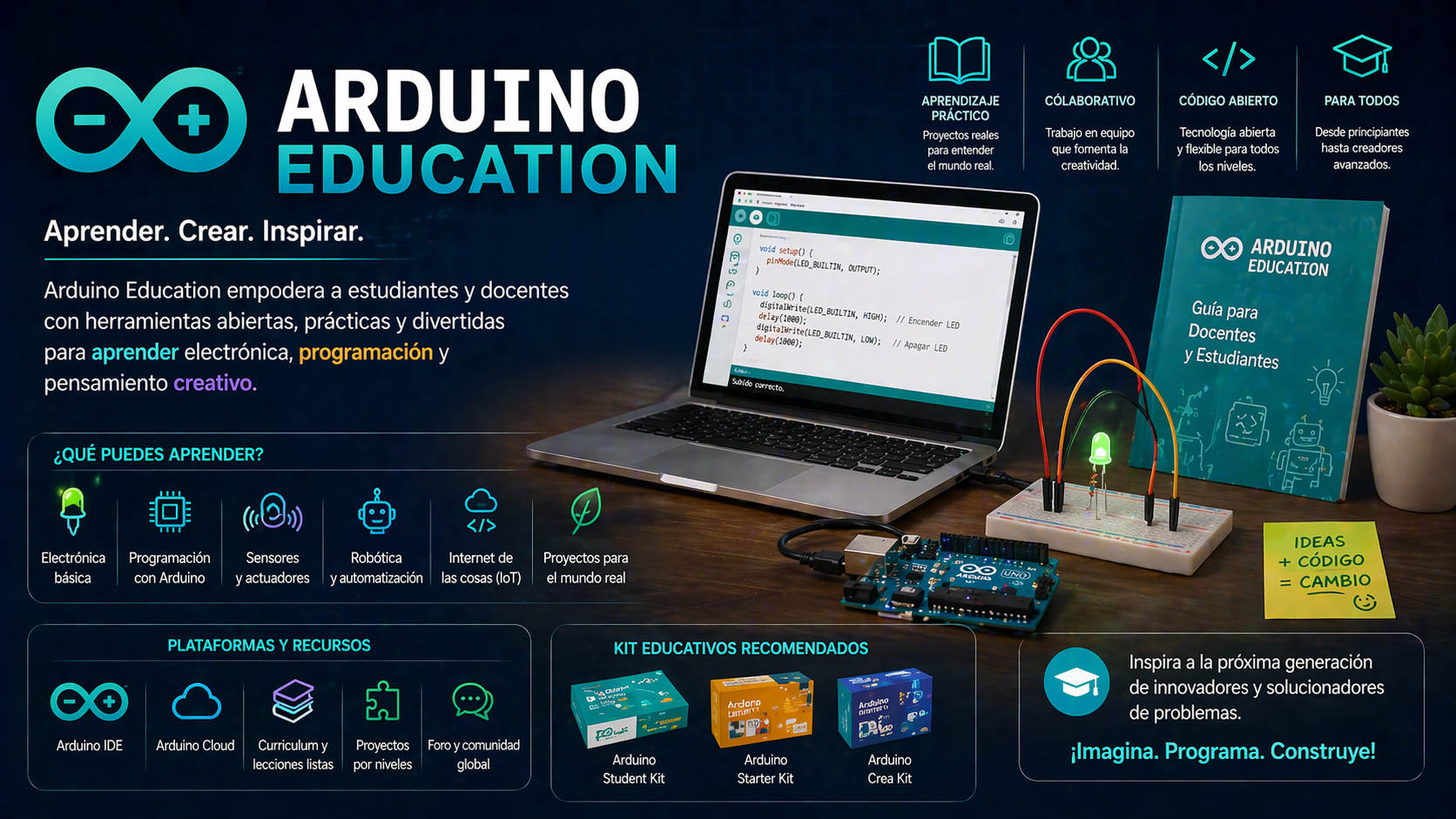
Incorporating robotics and programming into education is more than just a trend today: it has become a genuine necessity for preparing new generations. In this context, Arduino Education It stands out as a complete solution for transforming classrooms into true laboratories of creativity, technology, and innovation at any educational level. Whether in primary school, secondary school, or an after-school workshop, Arduino kits and resources are revolutionizing the way we learn science, technology, engineering, and mathematics (STEAM).
Would you like to take your classroom to the next level with hands-on projects? Are you a teacher, student, or trainer looking for ways to integrate robotics and electronics in a simple and engaging way? This comprehensive article delves into everything related to... Arduino Education ecosystem It can offer you everything from the methodology, the skills it develops, the different kits and lessons available, to the concrete resources and benefits for the entire educational community, including project ideas and access to the most relevant official material.
What is Arduino Education and why is it key to learning?
Arduino Education It is much more than a collection of circuit boards and electronic components. It represents a comprehensive educational approach, based on the philosophy "learning by doing" (learning by doing) and in the democratization of technology. Its objective is to bring electronics, programming and computational thinking closer to students of all ages and levels, even without prior experience, in the most accessible and practical way possible.
What sets Arduino apart in the educational field is its practical and collaborative methodologyFar from being merely theoretical, it fosters active student participation through real-world projects where students manipulate boards, sensors, motors, and open-source software, learning to solve everyday problems and create original inventions. Furthermore, the global Arduino community facilitates the exchange of projects, resources, and support among educators and students worldwide.
Pedagogical approach: learning by doing, creativity and essential values
under the motto "learning by doing"Arduino Education is committed to developing in the classroom essential 21st-century skills and collaboration, creativity, critical thinking, and problem-solvingEach kit or platform is designed to favor:
- Direct experimentation: Handling boards and components to understand how the technology works through experience.
- Trial and error: Understanding why some projects work and others don't reinforces motivation and meaningful learning.
- The use of creativity: Students not only reproduce circuits, but also design original solutions to challenges and learn to innovate.
This work philosophy is accompanied by some core values in its educational approach:
- Simplicity: Materials and lessons explained clearly to eliminate barriers and reach any level of knowledge.
- Inclusion: Open proposals for everyone, fostering group collaboration where any student can contribute their vision and learn at their own pace.
- Quality and support: Arduino Education has education specialists who advise teachers, in addition to offering top-quality materials in terms of both hardware and educational resources.
- Empowerment: The aim is for students to apply technology to solve real-world problems, not just follow instructions. This empowers them to use technology confidently and effectively in any context.
Arduino Education for all levels: Early Childhood, Secondary and Vocational Training
One of the great strengths of Arduino Education is its adaptability to student level:
- Primary and Early Childhood Education: With options such as pre-configured dashboards and guided projects, even the youngest children can delve into electronics and develop their first STEM skills in an intuitive and safe way.
- Secondary and High School: Arduino kits and platforms make programming and robotics easier through increasingly complex projects, introducing concepts of electricity, physical laws such as Ohm's law, digital logic, and programming fundamentals in a fun and applied way.
- Vocational training: The Arduino Education proposal also covers advanced technical levels, including learning about the Internet of Things (IoT), creating smart greenhouses, and other professional applications that are in high demand in today's job market.
Whether you are a primary or vocational education teacher, Arduino Education resources offer adaptability y Scalability to adapt to the pace and needs of you and your students, with progressive and clear materials from beginner levels to advanced challenges.
Arduino educational kits: step by step towards technology
To put all this into practice, Arduino Education offers a whole range of educational kits specially designed for the classroom. Arduino Education Starter Kit It's one of the most complete and recommended kits for beginners, but it's not the only option. Here we tell you the key features of the most popular kits and what one of the most in-demand includes:
What does the Arduino Education Starter Kit offer?
It is aimed at groups of up to eight students in pairs, providing everything necessary to learn the fundamentals of electronics and programming through practical activities. The kit contains:
- 4 plates Arduino UNO rev 3
- Mounting bases for each plate
- Adapters and 9V batteries
- Breadboards, capacitors, potentiometers, resistors of various values, LEDs of different colors, buttons and pushbuttons, temperature sensors (TMP36), phototransistors, jumpers and USB cables
- Advanced components such as servomotors, piezoelectric buzzers (buzzers), multimeters and other accessories
- Engineering notebooks for each student to document their experience as they progress
- Access codes to exclusive online contentwith materials for both students and teachers: guides, PDFs, step-by-step lessons and extension resources
These kits are designed for teamwork, fostering both collaboration such as individual discoveryYou can find more details and access official resources on the website of Arduino Education.
Step-by-step lessons: from theory to real practice
If there's one thing that characterizes Arduino Education, it's the quality and variety of their guided lessonsMost kits structure projects as follows:
- Introduction: first contact with the hardware, basic electrical safety rules and software installation.
- Fundamentals of electricity: Explanation of key concepts such as current, voltage, or the difference between parallel and series circuits, always with direct experimentation.
- Application of physical laws: and Ohm's lawhelping the student understand the operation of electrical components and measurements with real instruments (multimeters).
- First programmable projects: Using the Arduino IDE as a fundamental tool, you will learn to program simple circuits and basic control systems from the beginning, such as traffic lights or adjustable switches.
- Creative project development: As they progress, students have the opportunity to design and build more independent projects such as Christmas lights, small robots, or musical keyboards, consolidating the foundations of structured programming, the use of variables, conditional statements, loops, and serial communication.
- Projects with sensors and actuators: I work with potentiometers, light sensors, temperature sensors, servomotors and more, integrating the collected data into the control of my own inventions.
- Real-world applications: The kit culminates with social and environmental impact challenges, such as the creation of a automated greenhouse that measures and controls environmental variables or a light radar to transmit information using waves.
The didactic structure of these courses allows teachers without prior experience in electronics or computer science to guide their students in learning, relying on Notes for teachers, resources for expanding and providing direct technical support for the Arduino ecosystem.
Arduino educational projects: examples and practical applications
The challenges and projects that can be developed in the classroom with Arduino Education are as varied as the imagination of the students and teachers allows. Some examples based on official lessons and the Arduino community are:
- Programmable traffic lights: A classic for learning the basics of digital output programming and conditional logic, ideal as a first project.
- Smart lights: Circuits that change the lighting according to information from light sensors or user interaction.
- Sports robot: Using servomotors, it is possible to build a small programmable robot that performs actions such as hitting or throwing a ball, encouraging the integration of hardware and code.
- Musical keyboards and sound systems: Using piezoelectric buzzers, students can experiment with tone generation, learn about frequencies, and program simple melodies.
- Light radar: A project where a phototransistor is used to detect variations in light and transmit information through waves; ideal for understanding basic sensor and communication principles.
- Automated greenhouse system: When programming the control of variables such as temperature, humidity, light intensity or CO2 The concept of IoT is introduced, showcasing the potential of automation applied to sustainable development. You can find details of these types of projects directly on the official resource.
Educational resources and support for teachers and students
One of the reasons why Arduino stands out in the educational field is not only the hardware, but the range of available resources For teachers and students:
- Lessons and step-by-step guides: both in physical and digital format, to easily follow the proposed projects.
- Notes for teachers: with specific guidelines, extension ideas and resources to adapt the content to the level of each classroom.
- Engineering notebooks: Downloadable material for each student to document their progress and promote reflective thinking.
- Global Community: access to forums, collaborative groups and resources where you can share questions, projects and experiences with educators from around the world.
- Online platforms: They contain additional exclusive materials and provide technical support.
What is Scratch: a complete guide to the visual programming language for learning by creating
Arduino Education and the Internet of Things (IoT) in the classroom
Innovation goes a step further with Internet of Things projects introduced in the Arduino materials. Students discover how to connect sensors and systems to the cloud, monitor variables in real time, and automate responses. Examples such as the automated greenhouse They demonstrate the potential of integrating sustainability, technology, and home automation into interdisciplinary projects.
Arduino provides teachers with ready-to-use dashboards for working with younger students and IoT templates These activities are adapted for secondary school students, for example, in projects on smart agriculture, home automation, data science, and environmental management. This connects education with Industry 4.0 and the most emerging digital professions.
Key advantages of education with Arduino in the classroom
Integrating Arduino into educational programming offers benefits that go far beyond learning technology:
- It encourages autonomous and active learning, fostering student interest and effective participation in the class.
- Develop key skills such as teamwork, creativity, logical reasoning, and the ability to face challenges.
- It allows for the inclusion of all students, since the projects can be adapted both to those taking their first steps in technology and to those seeking to delve deeper into programming, electronics and robotics.
- It offers support and security, because the Arduino community and resources for teachers make the transition easier even if you don't have a lot of prior technological experience.
- Connect with the real world, From managing environmental variables in a greenhouse to creative robotics, learning to apply technology to current problems.
How to start integrating Arduino Education into your school
If you'd like to add Arduino to your classroom, we recommend:
- Review the official educational kits and compare them according to the educational level and objectives of your program.
- Visit the official website to learn about the available resources and guides.
- Consult partner platforms such as Technology Camp o Maker Store If you are looking for customized kits and support in Spanish.
- Start with small projects and increase the difficulty as your group gains confidence and skills.
- Take advantage of community resources and participate in forums, workshops, or fairs educational robotics to continue learning and being inspired.
The educational revolution is within your reach thanks to initiatives like Arduino Education. It's possible to design more dynamic, inclusive classes that closely reflect professional realities, stimulating creativity and a passion for technology at any educational stage.