
- La educational robotics It fosters STEAM skills and creativity from early stages.
- There are kits adapted for every age, from simple toys to advanced platforms.
- Robotics at home and at school motivates, develops social skills, and prepares for the future.
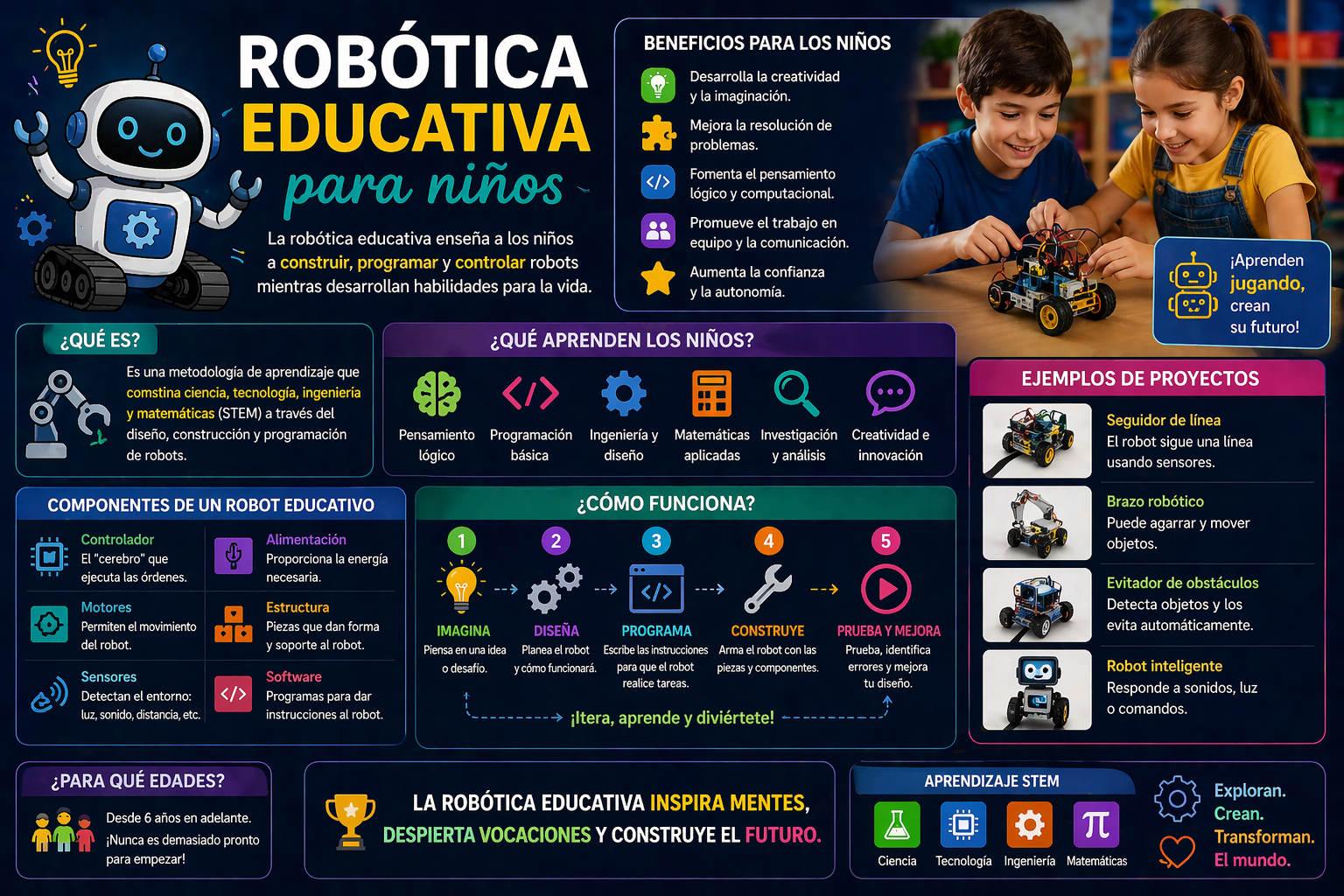
Educational robotics for children has taken a giant leap in recent years, becoming one of the leading methodologies for learning science and technology . More and more schools, families, and educational platforms are choosing to introduce young children to this world, not only because of the appeal of building and programming robots, but also because of the many key skills they develop for their personal and professional futures.
However, interest in educational robotics isn't limited to the classroom. The home sector is booming, thanks to increasingly accessible kits and toys adapted to all ages. This raises many questions: What exactly is educational robotics? How is it applied to children? What are its real benefits? Where to begin at home? And, above all, what materials are available and how to choose the best projects and tools for each learning stage? Below, we address these and many other questions in detail, integrating all available information so that any family or teacher has a complete and practical guide.
What do we mean by educational robotics for children?
Educational robotics is an innovative methodology that uses robots, construction kits, and related technologies as tools for cross-curricular learning. Thanks to these resources, children not only learn to build and program, but also develop multiple skills in a playful and interactive way: from problem-solving to strengthening their math, physics, creativity, and collaboration.
In the classroom and at home, educational robotics transforms abstract concepts into tangible experiences. Assembling a small vehicle, programming a sensor, or designing a circuit allows children to see and touch what is usually only explained in words in a book. This fosters learning by doing , a lasting and meaningful learning experience.
Why is educational robotics so important today?
The main appeal of educational robotics lies in its ability to motivate and spark the curiosity of young children about subjects they might otherwise consider complicated. Through play and experimentation, concepts such as force, energy, algorithms, and computational logic become fascinating and accessible.
Robotics also helps combat one of today's major challenges: the shortage of STEM (Science, Technology, Engineering, and Mathematics) students, especially girls. Introducing robots at an early age helps normalize technology and encourages children to investigate, solve problems, and ultimately, imagine themselves as the engineers, inventors, and scientists of tomorrow.
Benefits of educational robotics in child development
Learning robotics offers numerous benefits beyond acquiring technical skills. Some of the most notable, as mentioned by leading specialized websites and training centers, are:
- Boost creativity: By designing and building their own robots, children explore, test ideas, and unleash their imagination.
- Enhances logical and critical thinking: Programming and technical problem-solving foster an analytical mindset that transfers to other subjects.
- Strengthen STEAM knowledge: From science to mathematics, including engineering and technology, they are integrated naturally and practically.
- Improves communication and teamwork: Many robotics activities are done in groups, which promotes debate, consensus, and empathy among peers.
- It fosters autonomy and self-esteem: Overcoming one's own challenges, including programming or assembly failures, builds self-confidence.
Educational robotics also allows the learning pace to be adapted to each child's level. Through robots with varying degrees of difficulty, the experience is personalized to avoid boring children with overly simple challenges or frustrating them with excessively complex projects, as highlighted by platforms such as Robotix, Abacus, and Spacetechies.
From what age can one start?
One of the great advantages of educational robotics is that it can be introduced practically from preschool age. Today, there are kits and toys adapted for very young children, focused on basic construction activities, shape and color recognition, and initial steps in logic through sequencing. From age 5, children can begin with small, guided projects.
The progression is gradual: while manipulation and free play are key in preschool and the early years of primary school, as children grow, simple block-based programming is introduced, followed by the use of more complex apps or devices. Brands and specialized schools, such as LEGO, Makeblock, or Spacetechies, usually indicate the ages and levels for which their materials are designed.
What materials and types of robots exist?
- Starter kits: They include large, sturdy pieces, basic motors, and simple activities, designed for the youngest children (3-7 years old).
- Intermediate projects: From 7-8 years old, you can move on to kits with sensors, servomotors and block-based programming, which allow you to create mobile robots, controlled vehicles or small interactive machines.
- Advanced solutions: For secondary and high school, there are platforms that combine more powerful hardware and software, advanced programming and integration of 3D printers, Arduino or applied electronics, favoring more elaborate and personalized projects.
Among the most popular and recognized options are:
- Lego education y Lego boost: combination of classic blocks with smart modules, sensors and intuitive programming applications.
- Makeblock y Wonder workshop: platforms for developing everything from basic vehicles to autonomous robots and brain teasers.
- eSTEAM education y Abacus: shops and spaces specializing in materials and components for technological education at all levels.
- Other featured brands and toys: mbot, DocelRobot, Dash and Dot, Clementoni Doc, Tin Can Robot and Sntieecr.
How to choose the ideal robotics kit?
Choosing the right kit is crucial to ensuring a successful experience from the start. Key factors to consider are:
- Age and experience level: It's vital to choose projects that match the child's level of knowledge and manual dexterity. A very simple kit will bore them; an advanced one can frustrate and demotivate them.
- Educational objectives: What do you want your child to learn? There are options focused on basic electronics, others on programming, and many with a global approach to STEAM skills.
- Ease of use and support: Some kits include step-by-step guides, visual applications, and support resources to help users progress independently. Brands like LEGO and Makeblock stand out in this regard for the quality of their tutorials, which is essential for beginners.
- Compatibility and scalability: It is worth considering whether the kit allows for future expansion of projects, either with new parts, sensors, more advanced programming, or integration with other educational materials.
Finally, it's advisable to research the reputation and technical support of your chosen brand. Many large companies, such as LEGO Education and Makeblock Education, have years of experience in the sector and materials that have been tested in real-world educational settings.
Active learning as the cornerstone
Various pedagogical theories, such as Glasser's Learning Pyramid and Bloom's Taxonomy, agree that children retain much more when they learn through hands-on experience. According to these models, we only remember 5% of what we hear and 10% of what we read, but up to 75% of what we actually experience. This is why educational robotics makes all the difference: students don't just memorize, but think, build, activate, and play, seeing science "come to life."
What does teaching robotics to children really involve?
Working with robots isn't solely about training future programmers, but also about nurturing logical thinking, fostering curiosity, and teaching children how to face challenges from a young age. Youngsters begin by following simple instructions to assemble basic mechanisms, but soon they can innovate and design their own inventions.
Furthermore, robotics helps them understand complex scientific phenomena naturally: they discover concepts such as force, tension, energy, and how sensors and motors work. When they encounter difficulties in construction or programming, they face them without fear, and their eagerness to see the robot move motivates them to investigate, persevere, and collaborate.
Classes, workshops and practical projects
Robotics classes and workshops have proliferated in schools and specialized academies, especially in large cities. Places like Spacetechies, with locations in Madrid, offer courses for children as young as 5 and guarantee progressive projects so that each student can explore everything from basic electronics to 3D printing, always from a maker perspective and through collaborative work.
The workshops are often scheduled during holidays or school breaks, making them an excellent entry point. In a short time, a child can discover their passion for technology and decide if they want to delve deeper. According to data collected by Spacetechies, 90% are captivated after their first workshop.
Play plays a key role in robotics for children. It's no longer enough to simply build a robot: it's about challenging it with activities like navigating mazes, overcoming obstacles, or even engaging in mini-robotic battles with friends. Fun and self-improvement go hand in hand in these kinds of experiences.
[related url=»https://www.orienta21.com/que-es-la-pedagogia/»]
Toys and books: resources for learning at home
The market offers an increasing number of educational robotics toys for all ages, transforming learning into play almost without children noticing. LEGO Boost blocks, kits like Dash and Dot, MBot, or Tin Can Robot, and options from well-known brands allow children to get started and progress without requiring extensive prior knowledge.
To complement this learning, there are also very useful books designed for both teachers and self-taught families. Some common recommendations include:
- 'Educational robotics activities for the busy teacher', by Damien Kee.
- 'Building Robots for Hobbyists', by Gordon McComb.
- '50 technological projects of robotics and 3D printing', by Ernesto Martínez de Carvajal.
These manuals, however, are recommended for children aged 12 and up, or those with intermediate knowledge. Hands-on experimentation is usually the most effective approach for younger children, although these resources can support creativity and the development of technical and scientific skills at higher stages.
How to introduce children to educational robotics from home
For many parents, the first question is how to spark their children's curiosity and what initial steps to take. The key is to adapt both the challenges and the level of difficulty to the child's age and abilities. A first project can be as simple as programming a flashing light or creating a figure that moves when it detects an obstacle.
Best practices for getting started at home typically include:
- Look for kits with clear instructions, preferably with mobile apps or visual software.
- Establish weekly routines for play and learning, emphasizing overcoming challenges and collaboration.
- Take advantage of online resources, official tutorials, and basic courses, such as those offered by [company name], or Intergenerational Solidarity.
- Promote sharing by inviting family members to design and build together, and encourage children to freely personalize and modify their creations.
The most important thing is not to force things and to let the experience always be rewarding and motivating. Educational robotics also helps to strengthen frustration tolerance: often something doesn't work the first time, so children learn to investigate, consult resources, and persevere naturally.