
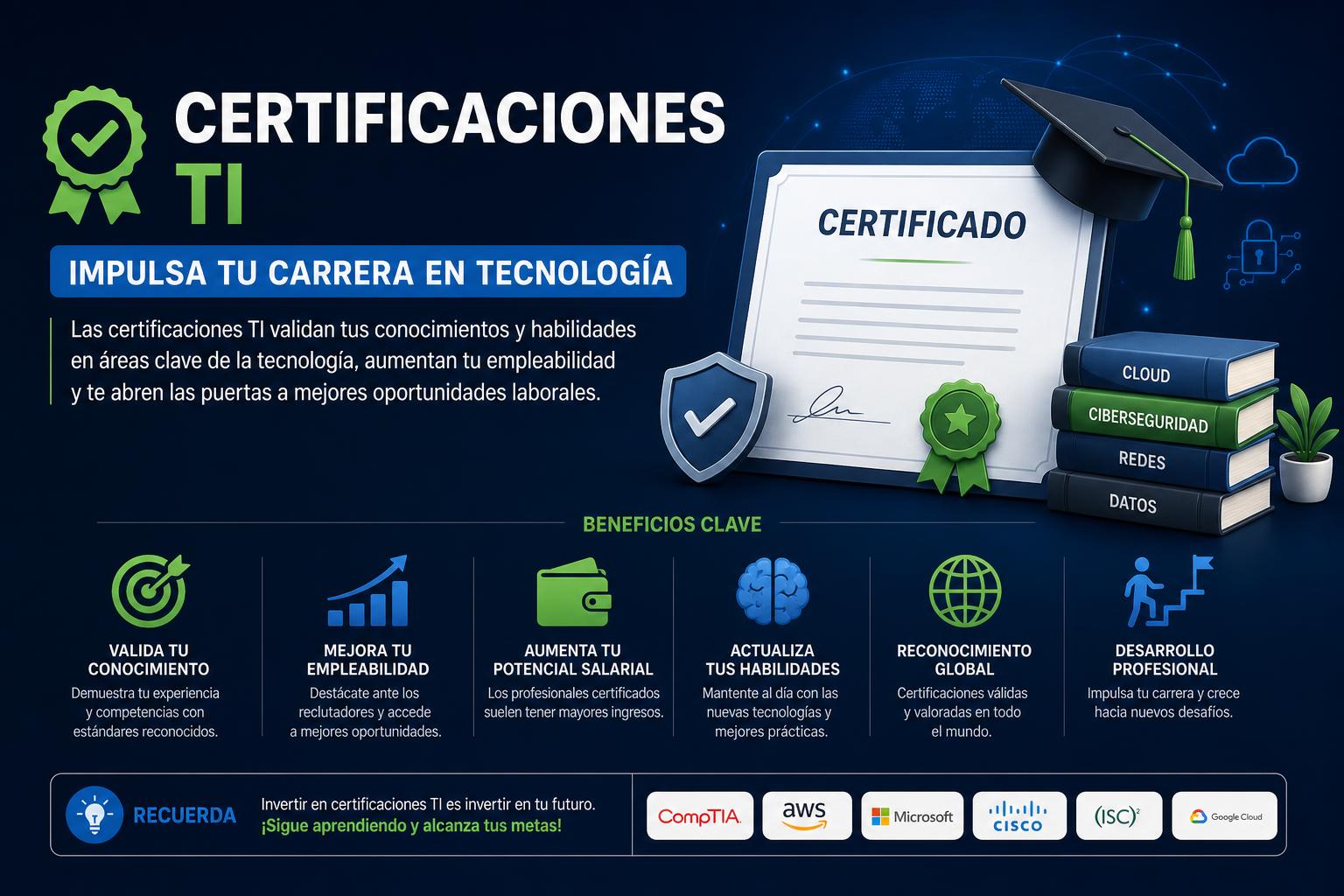
- IT certifications validated by official bodies increase employability and professional recognition globally.
- There are certifications adapted to each specialization (networks, cybersecurity, cloud, compliance, etc.) and level of experience (basic, advanced, expert).
- Selecting the right certification requires analyzing your professional goals, market demands, and available training resources.
- Obtaining and renewing IT certifications improves productivity, opens doors to internal promotion, and positions you for new technological opportunities.
The world of IT certifications is evolving at breakneck speed , pushing professionals in the sector to stay current and compete in an increasingly demanding job market. Earning an IT certification can be the key that opens many doors : from climbing the corporate ladder to accessing cutting-edge technology projects.
In Spain, IT certifications not only validate your knowledge and skills, but also represent a commitment to industry best practices and open up a wide range of professional and salary opportunities. This guide covers everything: from the most valued certifications to the application process, requirements, benefits, and how to fit each accreditation into your career goals. If your future lies in technology, this is for you—and then some!
What is an IT certification and why is it essential to your career?
An IT certification is an official accreditation issued by a recognized organization or technology body —such as CompTIA, ISC2, ISACA, Microsoft, or Cisco—that validates your knowledge and skills in a specific area of information technology. Obtaining one of these certifications typically requires passing a theoretical/practical exam that demonstrates your level of expertise in that specialty.
Why should you consider getting a computer certification?
- Improved job opportunities: Many employers actively seek certified professionals for positions of responsibility and specialized technical roles.
- Credibility and validation: These certifications demonstrate objective skills, recognized and validated by the industry, and make you stand out from other candidates.
- Higher salaries: According to various reports, certified professionals typically earn higher salaries than those without accreditation.
- Safety and labor mobility: Having certifications sets you apart in a highly competitive market and allows you to face technological challenges in different sectors.
- International passport: The main IT certifications are globally recognized, so you can work in virtually any country.
Key benefits of IT certifications in the technology sector
The value of certifications goes far beyond simply obtaining a diploma. They are an investment in your sustainable professional development . Here are some of the most notable benefits:
- Constantly updated: The IT sector is changing rapidly. Certification requires staying up to date in cutting-edge methodologies, regulations, and technologies.
- Networking: Access to professional communities, specialized forums and exclusive events related to the certification obtained.
- Development of transversal skills: Most certification programs promote technical, methodological, and communication skills, all of which are key in collaborative environments.
- Gateway to higher specializations: Many advanced certifications require prior completion of basic levels. This allows you to plan your career step by step, according to your goals.
Main types of IT certifications and their areas of application
The spectrum of IT certifications is very broad. You can specialize in networking, cybersecurity, service management, systems administration, artificial intelligence, cloud computing, data analytics, software development, compliance, data privacy, and other fields.
The most in-demand areas currently include:
- Cybersecurity: Instills knowledge to protect companies against digital threats, fraud, and risks.
- Computer Networks: Provides training in the design, maintenance, and troubleshooting of complex network infrastructures.
- Cloud computing: Specialization in deployment, administration and security of cloud environments (Amazon AWS, Microsoft Azure, Google Cloud Platform).
- IT and ITSM Service Management: Certifications related to the efficient management of technological services, aligned with business objectives.
- Data Management and Big Data: Related to the analysis, protection, and processing of large volumes of information.
- Privacy and regulatory compliance: Training experts capable of developing privacy programs that comply with regulations such as the GDPR.
The IT certifications most valued by companies and professionals
Let's now look at the most popular, in-demand, and recognized IT certifications in both the Spanish and international markets . Each one caters to different profiles and objectives, so you should analyze which one best suits your needs.
Cybersecurity certifications
- Certified Information Systems Security Professional (CISSP): A global benchmark for experienced security professionals. ISC2 It covers everything from risk management, security architecture and operations to communications security, secure software development and regulatory compliance. Requires a minimum of five years of experience in at least two CISSP domainsalthough one year can be validated with previous qualifications. It opens doors to leadership positions, consulting, and high-responsibility roles.and is a requirement in many leading defense organizations and multinational corporations.
- CompTIA Security+: Ideal for starting or advancing a career in cybersecurity. Validated and well-recognized worldwide (including by the U.S. Department of Defense), this certification ensures competence in risk management, incident response, and network and systems security. No formal requirements are requiredHowever, prior networking experience is recommended (for example, CompTIA Network +). Very useful for analysts, system administrators, and security technicians.
- Certified Information Security Manager (CISM): Demonstrates advanced knowledge of information security governance, risk management, security programs, and incident response. Issued by ISACA and requires five years of professional experienceBeing three in management roles and in certification domains. Aimed at managers, consultants, risk analysts and compliance officers.
- Certified Ethical Hacker (CEH): From EC-Council, this accreditation trains experts in ethical hacking techniques, security audits, and penetration testing. It requires two years of experience or have completed the official program. It is in high demand for evaluating and strengthening internal security systems. simulate real attacks and anticipate threats.
- Certified Information Privacy Manager (CIPM): From the IAPP, focused on privacy management and data protection in accordance with frameworks such as the GDPR and CCPA. It does not require strict requirements but it does require solid prior knowledge of privacy.Therefore, it is common among compliance officers, IT managers, and legal advisors.
Certifications in cloud computing and systems architecture
- AWS Certified Solutions Architect: Official Amazon Web Services Certification It validates the ability to design and implement scalable and secure cloud solutions. Requires a solid understanding of the AWS platform and hands-on experience. Highly valued in the administration of cloud infrastructures and enterprise architectures.
- AWS Certified Security – Specialty: Demonstrates advanced knowledge in protecting workloads on Amazon Web Services, including experience in IAM, data protection, and incident response. Requires two years of experience managing security in AWS and it is key for cloud architects and DevSecOps operations.
- Google Cloud Professional Cloud Architect: Google Cloud Certification for solution architects who manage complex cloud deployments, security, and performance.
- Certified Cloud Security Professional (CCSP): Conceived by ISC2Access is granted to those with proven experience managing cloud environments. Demonstrates proficiency in public, private, and hybrid cloud platforms, application security, regulatory compliance, and cloud governance. It requires five years in IT, three in security, and one in one of the CCSP domains..
Certifications in network and systems administration
- Cisco Certified Network Associate (CCNA): One of the most internationally recognized and respected certifications in computer networks. It validates capabilities in the design, implementation, configuration, and troubleshooting of OSI-based networks, including Cisco equipment and protocols.Ideal for those starting out or wanting to specialize in network engineering.
- Cisco Certified Network Professional (CCNP): Advanced level for those who already have experience in networks (CCNA or similar). It addresses planning, deployment, and troubleshooting of advanced network infrastructures.It requires passing a series of exams.
- CompTIA Network+: It offers knowledge and skills in network administration, maintenance, and configuration, without being tied to any specific vendor. It is often the logical next step. CompTIA A + or for those seeking initial specialization in networking.
- CompTIA A+: First essential stop to enter the IT world. It certifies basic skills in hardware, software, maintenance, diagnosis and support of computer systems and devices.Highly recommended for technical support, helpdesk, and basic administration profiles.
Certifications in IT service management and compliance
- ITIL Foundation: Considered the global cornerstone of IT service management (PeopleCertIt focuses on implementing best practices in processes and services aligned with business objectives. It is cross-cutting and applicable to all technology sectors.
- ISO/IEC 27001: Internationally recognized information security management certification. It guarantees global compliance in security, confidentiality, and quality in IT processes, ideal for companies and professionals seeking to stand out.
- ISO/IEC 20000: The counterpart in IT service management, ensuring efficient, secure processes with a commitment to continuous improvement.
- UNE-ISO/IEC 42001: Specifically for trusted AI, focused on companies that want to certify their artificial intelligence developments.
- National Security Scheme (ENS): Regulations focused on public environments and companies that work with data from the Spanish Administration.
Certifications for different professional levels
Beginners (first steps in IT)
- CompTIA A +
- Google IT Support Professional Certificate: Ideal for those who want quick access to technical support positionsVery comprehensive and practical, covering everything from hardware to customer service.
- CompTIA Network +
- Microsoft Certified: Azure Fundamentals: Introduction to the cloud ecosystem and the basic services of the Azure platform.
- HDI Desktop Support Technician: It fosters technical skills and excellent customer service abilities. It is geared towards those who provide desktop support and have direct contact with the user.
Advanced specialization and team leaders
- CompTIA Security +
- Cisco Certified Network Associate (CCNA)
- ITIL Foundation
- Microsoft 365 Certified: Modern Desktop Administrator Associate: It provides training for the comprehensive management and protection of devices and apps in complex business environments.
- CompTIA IT Operations Specialist (CIOS): binding of CompTIA A + y Network +, special focused on operational versatility in IT departments.
- Certified Information Security Manager (CISM)
How to choose the right IT certification for you
Not all certifications are suitable for every professional or every stage of their career. Choose based on your future prospects, previous experience, and specialization preferences.
- Define your specialization: Do you want to learn about networking, cybersecurity, cloud computing, AI, big data, service management, or privacy?
- Research market demands: Check job portals or LinkedIn to see what certifications companies require for the positions that interest you most.
- Choose recognized organizations: Always choose certifications with an international reputation (CompTIA, Cisco, Microsoft, ISACA, ISC2, PeopleCert, etc.).
- Choose the appropriate level: If you're just starting out, begin with basic certifications. If you already have experience or professional background, consider a mid- to high-level specialization.
- Search for training resources: Prioritize certifications whose exams can be prepared with official materials, courses, mock exams, and support from accredited instructors.
- Training modality/flexibility: Many offer online exams and self-paced learning. Take advantage of the option that best suits your needs.
- Networking and community: Choose certifications that include access to global communities of experts, as knowledge sharing will be key to your progress.
How to prepare for your IT certification: steps and tips
-
Choose the ideal certification: Think about your motivation, professional profile, and the skills you want to enhance or demonstrate.
-
Prepare for the exam: Review the formal requirements, study with up-to-date resources, and determine if there are official courses, simulators, or study groups you can take advantage of.
-
Scheduling and logistics: Register for the exam in advance through the official provider. The test may be in person or online, depending on the organization.
-
Passing the test: The exam usually combines multiple-choice questions, practical exercises, and real-world case studies. Make sure you understand the format well and practice beforehand.
-
Update your resume and professional profile: Once you have passed the certification, add it to your CV and LinkedIn (licenses and certifications section); this will improve your visibility to recruiters.
-
Keep your certifications up to date: Many accreditations expire after three years. Plan for renewals and stay current through seminars, continuing education, or recertification.
Competitive advantages of obtaining IT certifications
- Real job differentiation: In selection processes, having a current certification can be a deciding factor compared to other candidates.
- Professional and salary recognition: Certifications are seen as objective merits, which can translate into a better position and a salary increase.
- Efficiency and productivity: Certified professionals typically solve problems more quickly, apply best practices, and anticipate potential issues.
- Internal promotion and mobility: Many companies reward accredited technical training with access to new responsibilities and global projects.
Official certifications versus internal courses
While companies can offer internal training and corporate courses, the main difference with official certifications lies in their international validity and objectivity . ISO/IEC certifications issued by entities like AENOR validate processes globally, thus highlighting the value of both personal and business efforts.
Practical recommendations for preparing for your IT certification
- Create a realistic study plan, based on the syllabus and your experience.
- Use official study guides and perform practical exercises in real or simulated environments.
- Participate in forums and communities of experts in the specific area to resolve doubts and expand your knowledge.
- Don't leave registration until the last minute; find out about exam dates and requirements. presentation (documentation, format, etc.).
- Remember that each certification is usually renewed, so plan for recertification and ongoing training.
The role of IT certifications in digital transformation and business adaptation
Having certified teams enhances organizations' ability to meet the challenges of digitalization , the adoption of new technologies (cloud, AI, big data), data protection, and efficient service management. For both SMEs and large corporations, accreditation of best practices through certifications such as ISO/IEC 27001, 20000, or the ENS guarantees quality, robustness, and legal compliance.
The importance of combining certification and practical experience
Having a certification is essential, but professional experience remains crucial . Many exams include practical case studies that require real-world experience and in-depth knowledge of the technology. If you're a junior professional, look for internships or personal projects where you can apply what you've learned and solidify your skills.
The future of IT certifications: where the sector is headed
Trends point to an increased demand for experts in cybersecurity, cloud computing, compliance, data management, and artificial intelligence . Specific certifications in trustworthy AI, privacy (CIPM), and cloud integration will be key over the next decade to ensure that companies and professionals are prepared for the challenges of technological innovation.
- The rise of artificial intelligence with standards such as UNE-ISO/IEC 42001 will increase the need for certified experts in ethics and security in AI.
- Compliance and technological risk management will be unavoidable in sensitive sectors (finance, health, public administration, etc.).
- Cloud interoperability and security in hybrid environments will require skilled professionals with global accreditations.
Staying up-to-date and obtaining relevant certifications remains the most effective strategy to stand out and lead in the constantly evolving technology sector.
iSpring LMS: Everything you need to know about the leading e-learning platform