
- A classroom manager is the sum of pedagogical strategies and technological tools to organize, motivate and facilitate group learning.
- Successful management requires planning, consensus on standards, attention to diversity, and efficient use of time and space.
- Online platforms such as Google ClassroomInnovamat and MyRoom allow for the centralization of resources and improve communication and monitoring of students.
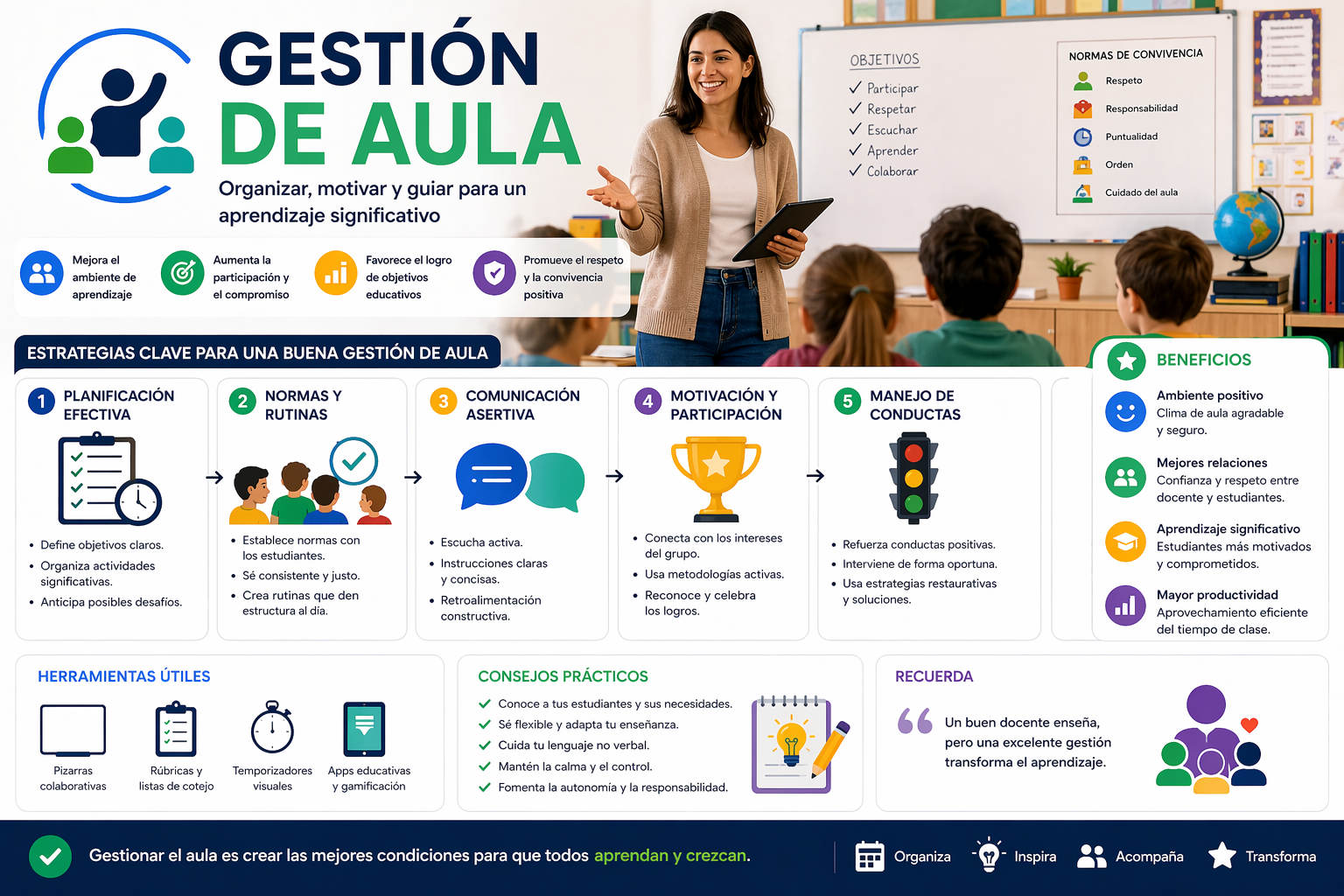
The world of education is constantly evolving, and a thorough understanding of classroom management has become especially important for both practicing teachers and those training to become future professionals. Classroom management encompasses much more than simply controlling and organizing a class: it involves a holistic view of group dynamics, the use of innovative tools, the design of inclusive learning environments, and the development of positive relationships among students, teachers, and families.
In this article, we will explore in depth the meaning, functions, and resources of a classroom management tool, as well as best practices for effective management that contributes to a positive learning environment and improves teaching and learning outcomes. If you are a teacher, a student teacher, or interested in educational innovation, here is a comprehensive and up-to-date guide drawn from the most relevant sources that rank highly in search engines.
What is a classroom manager?
The concept of classroom management encompasses two main dimensions. On the one hand, it refers to the set of actions, decisions, and skills that teachers develop to plan, organize, and coordinate classroom activities, avoiding improvisation and fostering learning. On the other hand, it also refers to the digital platforms and technological tools that facilitate the management and monitoring of tasks, materials, and resources during lesson sessions.
Therefore, the classroom manager can be understood as the organizational and methodological foundation that allows teachers to create a structured, motivating, and safe environment, both from a pedagogical perspective and thanks to available technological advancements. This function includes everything from designing rules, routines, and protocols, to space allocation, time management, addressing diversity, conflict resolution, and even using digital management platforms such as Google Classroom, Innovamat, or MyRoom, which transform planning and workflow.
Classroom management: much more than discipline and control
In the past, classroom management was primarily associated with maintaining control and silence in the classroom, seeking to prevent disruptive behavior. However, current research and teaching experience demonstrate that true classroom management is much more complex and enriching . Its main objective is to guarantee a healthy learning environment where respect, cooperation, motivation, and personal development are key pillars.
- organization of spaceDistribute tables, chairs and materials according to needs, opting for different groupings (individual, pairs, cooperative teams) and ensuring accessibility and comfort.
- Design of rules and routines: agree on rules of coexistence and procedures for entry, exit, teamwork, participation, etc., allowing autonomy and stability.
- Time management: Plan tasks and activities within realistic timeframes and using resources such as timers, quick notes, or a shared calendar to optimize the pace of sessions.
- Positive emotional climate: to create cordial and trusting relationships between students, teachers and families, fostering empathetic communication, self-esteem and active listening.
- dispute resolution: develop dialogue strategies, mediation, immediate intervention and teaching of socio-emotional skills as an alternative to traditional punitive measures.
The central role of the teacher as classroom manager
The teacher is the driving force behind classroom management. They not only design and adapt activities, but also act as a role model, guide, and facilitator for the class. Their main functions include:
- Session Planner: program and contextualize the activities according to learning objectives, assess prior knowledge and adapt the pace and content to the characteristics of the group.
- Learning facilitator: It fosters autonomy, critical thinking, and active student participation, motivating meaningful learning and experimentation.
- Promoter of respect and coexistence: establishes close but firm relationships, fostering cooperation, inclusion and recognition of individual diversity.
- Evaluator and feedback provider: observes and records progress, using different formative assessment tools, and provides clear, specific and constructive feedback, as well as managing sanctions and rewards if deemed appropriate.
- Technology user for management: uses digital tools to organize tasks, share materials, correct work, and promote communication in virtual environments.
Key elements in pedagogical management within the classroom
Good classroom management is the result of a balanced combination of the following five elements:
- Student: key protagonist of the process, with diverse needs, skills, interests and situations.
- The teacher: co-protagonist, with adaptive skills and a vocation to accompany, correct, inspire and guide.
- The learning: the methodologies, techniques, resources and activities (gamification, cooperative learning, flipped classroom, etc.).
- WeatherEvery minute is valuable and should be used wisely, avoiding delays and following well-structured phases.
- Space: a physical and emotional space, flexible and open to new ways of distributing groups and promoting interaction.
Digital tools: the rise of classroom management platforms
Digitalization has brought about a true revolution in classroom work and management. Online classroom management platforms have emerged that simplify the organization of and access to resources, offering both logistical and methodological advantages.
Among the main options, the following stand out:
- Google ClassroomIdeal for creating virtual classrooms, assigning tasks, evaluating, storing work, providing feedback, and promoting online collaboration. Free, intuitive, and fully integrated with G Suite. Google Drive. Enables immediate communication and motivation for the students.
- A platform designed for teachers who want to optimize each session with organized materials, access to videos, podcasts, tailored resources, explanations of competencies, and a dynamic system that updates according to teachers' needs. It includes a digital whiteboard option and access to exclusive training.
- InnovamatA web-based tool that centralizes specific resources for teaching mathematics, allowing users to prepare lessons, access videos, graphic organizers, and project materials with a single click. It stands out for offering teacher training and an activity library, available in several languages and for different educational levels.
These platforms allow teachers to have all the content structured session by session, personalize deliverables, save time, improve feedback, and always stay up-to-date with the latest training developments.
Advantages of a good classroom management system (digital or traditional)
- Saving time and effortIt allows you to centralize materials, resources and communications, eliminating the dispersion and chaos of documents, printing or last-minute searches.
- Accessibility to multimedia and educational resourcesThe teacher can use videos, audios, podcasts, presentations and even immediate explanations from experts, enriching the session.
- Continuous updating and adaptation: Possibility of modifying and expanding resources in real time according to the evolution of the group, with living systems subject to improvements and suggestions from the professionals who use them.
- Training & supportThese platforms often provide access to events, webinars, workshops, and communities where you can share experiences and receive support.
- Instant visualization of task status and gradesThe teacher knows at all times who has submitted work, who needs support, and how each student is progressing.
- Promoting self-assessment and peer assessment: Incorporation of rubrics, comments, submissions and reviews so that students learn to self-regulate and improve their performance autonomously.
- Increased motivation: Intuitive, attractive and native platforms for students, which encourage participation and involvement in their learning process.
- Direct and secure communicationThey facilitate innovative contact between teachers, students and families, with messages, announcements, clarifications and structured feedback.
How to plan and organize a class with a classroom management system
Lesson planning is one of the key aspects of management. To design effective sessions, it is recommended to structure them in three distinct phases:
1. Prior work: planning before the class
- Define clear objectives For the session: what are the students expected to learn?
- Gather information from the starting point: diagnosis through formative assessment tools, such as exit tickets or short tests, to adapt content if necessary.
- Assess logistical limitations: available space, groupings used, availability of technological or material resources.
- Selecting resources and methodologies according to the interests and needs identified.
2. Class development: phases and resources
- Home: Established routines, review of previously learned material, explanation of the agenda or objectives for the day.
- Development: Mini-lectures, practical activities, teamwork, debates, gamification, use of videos or interactive resources, personalized follow-up according to the group's progress.
- Closing: Review of what has been learned, assessment of individual and group work, collection of materials, setting of challenges for the next session and orderly closure (never leave the class "haphazardly").
3. Post-assessment: feedback and continuous improvement
- Teacher reflectionWhat worked, what should be adapted, notes for future occasions.
- Incident or improvement log: Record changes to share with other teachers or teams.
- Quick and specific feedback to students, preferably through digital platforms, but also in person.
The Educational Project and shared management
Effective classroom management is not limited to the individual teacher's role; it must be integrated into the overall organization and philosophy of each school, as outlined in its Educational Project . This document establishes guidelines, consensus on rules, roles, space allocation, conflict resolution, and strategies for addressing diversity.
Achieving effective management therefore involves agreeing on procedures, rules and routines from the beginning of each course, making them visible and known to the entire educational community and reviewing them periodically to adapt them to changes (new equipment, students, changes in context, etc.).
Disseminating the Educational Project and the agreements reached is essential for any new teacher or student to integrate quickly, avoiding confusion and fostering a positive atmosphere.
To know, value and motivate the students
The key to good classroom management is to know each student well : their interests, abilities, strengths, possible difficulties, and personal and family environment.
- Presentation activities, interest radar, rapid tests, interviews with families, systematic observation… are fundamental resources to identify potential and design an inclusive environment.
- The teacher must to see each student as a whole personnot only as a recipient of instruction, but also in their emotional, social, and cognitive dimensions.
- Boost social emotional learning It is fundamental: emotional intelligence, management and expression of emotions, self-esteem, resilience, development of life skills and responsible decision making.
- Promote autonomy: propose open activities, promote self-management of time, self-evaluation and responsibility in individual and group work.
Space distribution and groupings
The physical layout of the classroom and the groupings have a powerful influence on the dynamics and learning:
- Traditional arrangementTables in rows facing the blackboard, suitable for presentations but less dynamic for interaction.
- Cooperative teams: tables in heterogeneous groups of 4-5 students, rotation of roles and promoting peer tutoring (cooperative learning).
- Flexible groupings: spontaneous teams, expert groups, assembly dynamics, according to the needs of each activity.
- Agreement in the center to respect the agreed distribution, returning the basic arrangement at the end of each session.
The organization of the space must be aligned with the Educational Project and the methods used, debating and reaching consensus on criteria in cycle meetings, teaching teams and governing bodies.
Role of rules, protocols and routines
For active and effective management, it is essential to agree upon and make visible the rules, protocols, and routines that regulate:
- Inputs and outputs from the classroom.
- Signals to get attention or silence (highly valued is the consensus on a simple and inclusive signal, such as raising your arm and putting your finger to your lips).
- How teams are formed and assigned roles.
- dispute resolution: steps, mediators, available resources.
- Use of resources and materials.
- Time management and the transitions.
These routines help reduce anxiety, increase student autonomy, and ensure consistency in treatment and coexistence.
Time management and efficiency at work
One of the most frequent challenges in daily teaching is making good use of available time . To do this, it is advisable to:
- Use timers or stopwatches in specific tasks to develop responsibility and effectiveness.
- Alternate individual, partner, and group activities, depending on the time of the session and the degree of autonomy achieved.
- Avoid improvisation and the waste of minutes in transitions, having a clear work plan for the day.
- Leave room for feedback and reviewing before the end of the class, avoiding rushing and leaving the classroom without collecting or summarizing the learning.
The classroom climate and daily coexistence
A positive classroom climate is the best predictor of good academic and social outcomes:
- It means that each student feels safe, accepted and valued, both by the teachers and by their peers.
- Promote a culture of diversity and inclusion From day one, dismantling prejudices and stereotypes.
- Promote cooperative dynamics, service-learning projects and cross-cutting activities that strengthen interpersonal relationships.
- The cohesion of groups and grassroots teams is worked on systematically and not only at the beginning of the course.
Conflict resolution in the classroom
Conflicts are inevitable, but effective management turns them into learning opportunities :
- Mediation, immediate dialogue intervention, and the establishment of educational consequences are preferable to resorting only to incident reports or punitive sanctions.
- It is vital to establish clear steps and protocols for action, integrated into the Educational Project and known by the entire community.
- Conflicts should be treated as part of the process of developing civic and personal competence.
Active methodologies and resources for inclusion
Adopting varied methodologies allows us to respond to diversity and maximize the potential of each student. These include:
- Cooperative learning: structuring heterogeneous teams, assigning roles, fostering peer mentoring and promoting shared responsibility.
- Project-based learning (PBL), guided research and real problem situations.
- Gamification and the use of digital resources to increase motivation and engagement.
- flipped classroom: reverse the traditional model so that students prepare content outside of class and use the classroom to apply and consolidate what they have learned.
- Service-learning: integrate challenges and tasks that have a positive impact on the community.
- Use of accessible technologies: digital whiteboards, multimedia resources, inclusive applications to accommodate functional diversity.
The role of families and the educational community
Efficient classroom management always relies on collaboration and communication with families :
- Informing and establishing regular contact helps to understand personal situations and adapt the educational intervention.
- It promotes co-responsibility and teamwork for the benefit of the students' learning and comprehensive development.
- It builds trust, reduces misinformation about potential difficulties, and promotes academic success.
Formative assessment and effective feedback
Assessment for improvement is essential to good classroom management. The most effective practices combine:
- Continuous and formative assessment, using varied instruments: written tests, presentations, practical tasks, observation and self-assessment.
- Organized record of progress, taking advantage of the functionalities of digital platforms.
- Individual and group feedback, immediate, specific and suggestive of best practices.
- Use of rubrics, reports and notes shared with the students themselves and, when appropriate, with the families.
Classroom managers: evolution according to educational levels
Classroom management platforms have proven their usefulness for all educational stages, from preschool and primary to secondary. They stand out for their flexibility, scalability, and adaptability to changing needs. Some projects and their main features:
- Innovamat (https://www.innovamat.com/): focused on the teaching of manipulative mathematics and competency-based experiences, covering from preschool to secondary school.
- MyRoom (Tekman): global management of daily sessions, materials, audiovisual resources, external explanations and continuous teacher training.
- Google Classroom: full integration with digital work, storage of evidence and materials, individual and group tracking.
These tools enhance teacher autonomy, allow the sharing of best practices, collect data for continuous improvement, and are progressively integrated with the information and rating systems of the centers.
Teacher training and professional development
To master classroom management, experience alone is not enough; ongoing training is also essential . Educational institutions are increasingly investing in practical, on-site training, workshops, online courses, and peer supervision that allow the entire teaching team to review and improve their practices.
- Participating in learning communities, teacher networks, events and webinars improves management and methodological updating.
- The exchange of materials, routines, protocols, and successful activities reduces improvisation and strengthens faculty cohesion.
Final Thoughts
Classroom management requires balancing planning, support, innovation, and personalized attention . Effective management involves a holistic vision, coordination with the entire educational community, and an adaptable presence. Space allocation, resource selection, activity design, and conflict management are fundamental decisions that influence the quality of the educational process.
Integrating regulations, protocols, and technologies into daily routines helps transform the experience into an opportunity for growth and learning. Teachers who understand and apply effective principles create more dynamic, safe, and motivating classes, promoting not only academic performance but also the social and emotional development of their students. Innovation, inclusion, and continuous improvement are key factors in classroom management, a fascinating microcosm that demands commitment, creativity, and passion in every action.
ClassDojo: The definitive guide to the educational platform that is transforming the classroom