
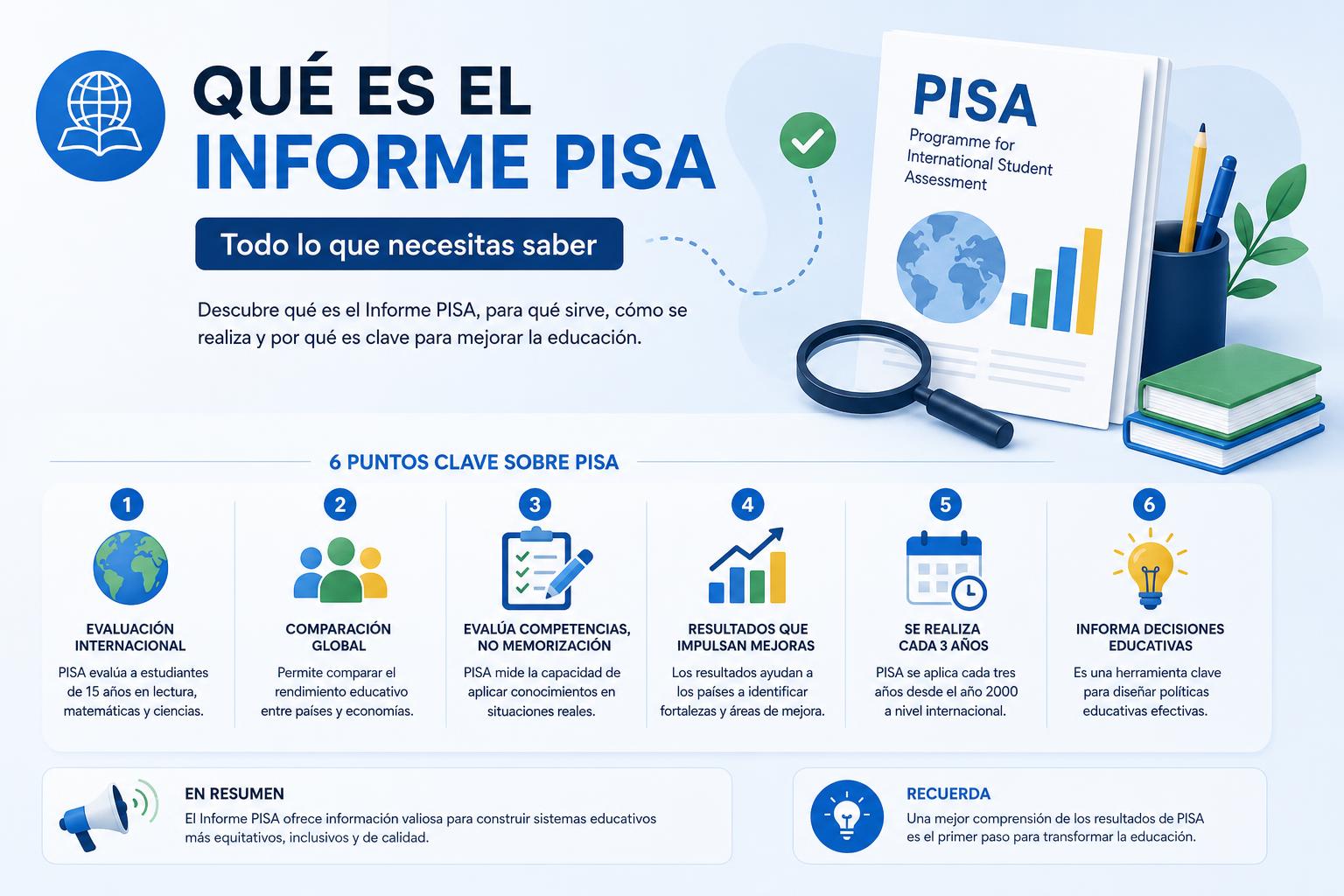
- PISA compares the educational skills of 15-year-olds in more than 80 countries, focusing on reading, mathematics, and science.
- The report has a direct impact on educational reforms, generates political and social debate, and detects inequalities within and between countries.
- Spain has participated since 2000, with variable results, worrying trends and large differences between autonomous communities.
You've probably heard of the famous PISA report and wondered what exactly it is, what it assesses, and why there's so much fuss every time the results are published. It's not just any exam: PISA is, in fact, a global barometer that measures and compares the educational level of students in more than 80 countries. And yes, Spain has been on that list since its inception in 2000.
In this article we will break down in a clear, engaging and comprehensive way everything you need to know about the PISA report: what it is, how it works, how the tests are done, what the results mean for the Spanish education system and for other countries, interesting facts, criticisms and evolution with recent data and very interesting comparisons.
What is the PISA report and who organizes it?
PISA (Programme for International Student Assessment ) is a major assessment promoted by the Organisation for Economic Co-operation and Development (OECD) , which you can consult on the official PISA website . The main objective of this study is to measure and compare , in a standardized way, the level and skills of 15-year-old adolescents in three key areas: science, reading, and mathematics.
This program not only assesses theoretical knowledge , but goes further: it seeks to evaluate how students apply that theory in real-world situations, everyday problems, or practical contexts. The ultimate goal is for countries to improve their education systems through objective analysis, using it as a benchmark for policies, reforms, and public debates.
Why is PISA so relevant?
The importance of the PISA report lies in its international reach and its objective and systematic approach to comparing education across different countries. Each time a report is published, the impact is immediate: politicians, teachers, families, the press, and the educational community itself analyze the results in minute detail because they reflect strengths, weaknesses, and trends not only in Spain, but also in our European neighbors and worldwide.
PISA is key to guiding educational policies , identifying inequalities, and driving the debate on the future direction of education. Furthermore, it influences public perception of education, pushes for improvement, and allows us to determine whether educational reforms are truly effective.
Who participates and how often is it done?
Every three years, the OECD invites more than 80 countries to participate in the PISA tests. Spain has participated in every edition since 2000. These tests are open to 15-year-old boys and girls regardless of their grade level, as this is the age at which they traditionally finish compulsory education.
The evaluation is by country, but there are also cases of regions that participate separately (for example, Chinese regions or Spanish autonomous communities).
What exactly does the PISA report measure?
PISA focuses on three fundamental areas:
- Reading: The ability to understand, interpret, and reflect on written texts.
- Math: Not just the calculations or the theory, but the ability to apply them to solve real problems.
- Sciences: Skills to understand basic scientific concepts and use them in practical situations.
In each edition, one of these competencies is the main focus . For example, in 2022 and 2025 the focus is on mathematics, while in previous editions it has been reading or science. Furthermore, each cycle introduces an innovative competency: problem-solving, creative thinking, global competence, or financial literacy, adapting the types of skills assessed to the challenges of the 21st century.
How are students selected and examined?
The assessment is conducted on a representative sample of 15-year-old students in each country, typically between 4.500 and 10.000 randomly selected students. Each student takes a different test : several booklets are used to ensure the exam covers a wide variety of questions and situations.
The exams combine:
- Closed questions (multiple choice): Only one correct answer, designed to be quick.
- Open questions: The student must develop the answer, argue or justify their solution.
In addition to the exam, students complete a questionnaire about their socioeconomic environment, their habits and their family life , allowing academic performance to be associated with external factors such as the level of education of the parents, the school climate or access to technology.
What is the purpose of the PISA report?
The purpose of the report goes far beyond simply ranking countries. It allows each government to understand the actual educational performance of its students compared to other education systems, compare trends, evaluate the success of its policies, and identify challenges, timely inequalities, and areas that require intervention.
In fact, much of the educational reform in recent years in Spain and internationally has been aimed at improving the skills reflected in PISA: reasoning, practical application, understanding in real contexts , etc.
A brief history and evolution of the PISA study
PISA began in 2000 as a pilot project managed by the OECD. In its initial editions, participants were primarily from Europe, North America, and developed Asia. Gradually, countries from around the world have joined. Spain has participated since the beginning and continues to do so in its most recent versions, such as the 2022 and 2025 editions (originally planned for 2024 but postponed).
The structure of the cycles consists of:
- The exam is repeated every three years, changing the central area of evaluation.
- New skills adapted to the times are incorporated, for example, collaborative problem solvingcreative thinking or financial competence.
- Adolescents from different backgrounds are evaluated to ensure realistic representation.
How is PISA published and communicated?
PISA results are presented in comprehensive official reports that can be accessed interactively. These typically include score tables, trend graphs, analyses by autonomous communities, comparisons between countries, and even global rankings. Results for new competencies are also reported, and additional modules are published if a special test is introduced (such as digital reading or creative thinking).
How are the results interpreted?
The report assigns each country an average score (the well-known PISA results) for each area. The OECD average is usually the main benchmark for assessing a country's progress or decline.
PISA does not assign "high marks" or "high marks," but rather serves to place each country in a comparative context. Furthermore, it reveals the differences between autonomous communities and regions (in the case of Spain, the differences between, for example, Castile and León, Galicia, and Andalusia are significant).
Which countries stood out and how did Spain fare?
In the latest edition (PISA 2022), Singapore led in all three areas : mathematics, science, and reading. It was followed by Macau, Taiwan, Hong Kong, and Japan, along with European countries such as Estonia, Switzerland, and Canada. Austria, Ireland, Denmark, Poland, and Belgium typically remain near the top. You can find details and official tables on the OECD's official PISA 2022 website.
Regarding Spain, its trend since 2018 shows a slight decline. In 2022, the results were:
- Math: 473 points (OECD average 472)
- Reading: 474 points (OECD average 476)
- Sciences: 485 points (OECD average 485)
In reading, Spanish students barely approach the OECD average, and performance has declined compared to previous years, with a drop particularly affecting mathematics and reading. The pandemic has influenced these results, and some adjustments to the samples, such as the exclusion of Catalonia in 2022, may have altered international comparability.
Specifics of the tests and differences between countries
- In Spain and Portugal, the rate of students who choose Vocational Training is one of the lowest in Europe (24%), compared to almost 65% in Finland or 76% in the Netherlands.
- Belgium presents a significant difference between the Flemish and French-speaking regions. In Switzerland, the differences between linguistic areas are small, although the Italian region has slightly lower results.
- Linguistic minorities or immigrants tend to perform worse than the national majority. This can be seen, for example, in Finland, where the Swedish minority has lower scores, or in Canada, where the Anglophone majority performs better than the Francophone majority.
- The differences between autonomous communities in Spain can even surpass some international comparisons. For example, Castilla y León maintains higher results, while other regions are below.
How have scores evolved in Spanish-speaking countries?
Spain, Chile, Mexico, Argentina, Peru, Colombia, Uruguay, Costa Rica, Panama, and the Dominican Republic regularly participate in PISA. Although Spain has consistently performed below the OECD average, it has outperformed other Spanish-speaking countries, though recent trends indicate a decline in its scores.
Summarizing the data from recent years:
- En readingSpain fell from 493 points in 2000 to 474 in 2022; Chile has improved progressively; Mexico and Argentina maintain low results.
- En mathematicsThe trend is similar: fluctuations between 476 and 486 points in previous years, but dropping to 473 in 2022, with countries like Chile, Mexico and others below the OECD average.
- En sciencesSpain registered a drop from 491 in 2000 to 485 in 2022, with countries like Chile and Uruguay still below.
What other international studies exist and how does PISA compare?
In addition to PISA, there are TIMSS and PIRLS, which assess different age groups and use different methodologies. Although the results are often correlated, PISA stands out for its global coverage and the innovative aspects it includes in its analysis.
What criticisms does PISA receive?
Despite its recognition, it has received several criticisms:
- Some question whether it evaluates reasoning and general intelligence more than specific knowledge of the school curriculum. This may reflect social and cultural inequalities rather than the quality of education.
- Samples from countries like China may be biased. For example, Beijing or Shanghai represent all of China, which raises doubts about their actual representativeness.
- Comparisons of means do not always reflect the distribution of performance. There may be countries with similar averages that have very different profiles.
- The ranking promotes a simplistic view of education, focused on quantitative results that may overlook important aspects such as inclusion or emotional well-being.
Although there is debate, it is recognized that PISA has driven educational reforms and policies worldwide, serving as an instrument for reflection and improvement.
Innovative competencies and future impact
Since 2012, skills such as financial literacy, collaborative problem-solving, global competence, and creative thinking have been incorporated. By 2025, digital and foreign language skills are expected to be assessed, adapting the evaluation to the demands of the 21st century.
The impact of PISA transcends the results: it guides future educational trends and encourages the adaptation of education to a digital, creative and collaborative world.
What is the PISA-D test?
The PISA-D (PISA for Development) assessment is a project for developing countries, adapting the methodology for children and young people who are in the process of schooling or out of school, in countries such as Ecuador, Paraguay, Cambodia or Senegal.
Example of impact: results and political debate in Spain
In Spain, PISA results serve as a benchmark for political and communication decisions. Governments use them to justify educational reforms and approaches, and the press presents them in national and international rankings. The decline in results in 2022, especially in mathematics and reading, has generated debate and pressure on educational policies, in a context where the pandemic has had a significant impact.
To what extent do external factors affect the results?
The school system is not the only factor influencing outcomes: socioeconomic status, school climate, inclusion policies, and informal learning also play a significant role. Analyzing these factors opens up a debate about equality and the quality of education.
Changes and improvements following PISA
The report has prompted reforms focused on:
- Expand skills: such as critical thinking, problem-solving, and lifelong learning.
- Promote equality: detecting inequalities in order to address them effectively.
- Adjusting the curricula and pedagogical methodologies to respond to current challenges.
- Better teacher training and renew assessment techniques.
These changes aim for a more innovative, inclusive education adapted to the needs of the 21st century, with an impact on school management and teacher training.
The PISA report has solidified its position as the key tool for diagnosing and comparing the health of education systems, driving reflection on the quality, equity, and efficiency of education worldwide. Its findings are essential for families, teachers, and policymakers seeking to understand and improve the learning of future generations.
Notion in education: The ultimate tool for students and teachers