
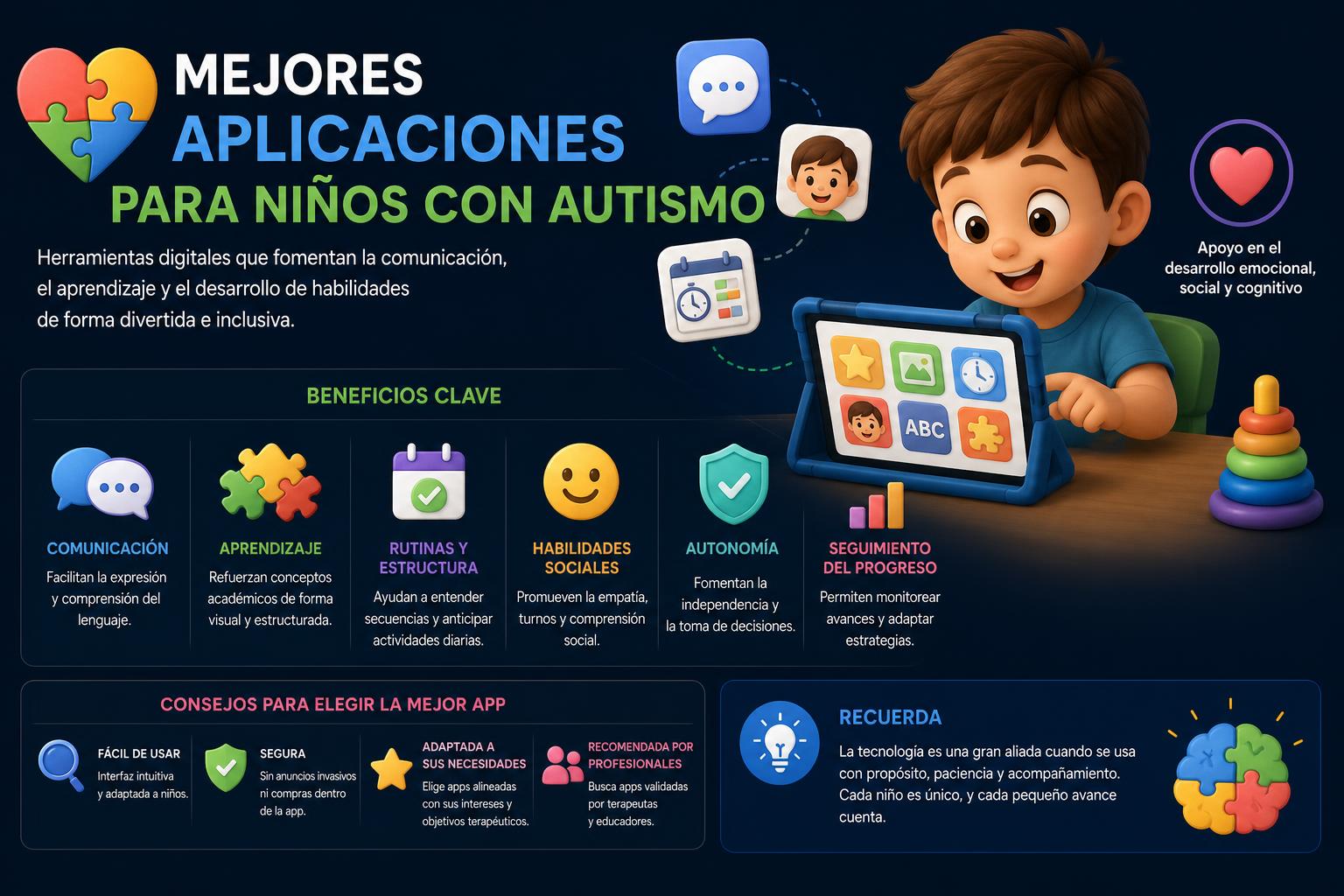
- Apps for ASD cover communication, autonomy, emotional management, and learning.
- Most offer visual reinforcements and customization according to individual needs.
- Guided and adapted use enhances motivation, inclusion, and development in children with autism.
Technological advancements have revolutionized how children with autism can learn, communicate, and develop their social skills. An increasing number of apps are being designed specifically to make life easier for children with Autism Spectrum Disorder (ASD) , helping both their families and professionals in their daily lives. Currently, there is a wide variety of apps for all kinds of needs: from improving communication and academic learning to supporting emotional development and daily routines.
In this article, we offer a comprehensive and detailed guide to the best apps for children with autism, compiling the most complete information from specialized sources, educational publications, and real-world experiences. You'll discover practical tools to stimulate language development, establish routines, foster independence, support augmentative and alternative communication (AAC), and even exercise memory and logical reasoning . Join us as we show you how technology can be a powerful ally in the development of young children on the autism spectrum.
Why use apps in autism intervention?
Educational and support apps for children with ASD offer numerous advantages over traditional methods. First, they provide motivation and positive reinforcement through a safe, predictable, and dynamic environment , essential for children to develop their abilities more naturally. They also facilitate access to structured learning , adapted to each child's pace and level, allowing for personalized goals and challenges based on their skills and interests.
Many of these apps are created in collaboration with autism experts and educators, and their design includes visual elements, pictograms, and interactive exercises that are especially effective for children who process visual information better than auditory information. Thanks to their versatility, they can be used at home, in therapy sessions, at school, or in any everyday context , always with supervision and following the individualized intervention program.
Things to consider before launching an app
Before choosing an app, it's important to consider the child's individual characteristics : age, developmental level, preferences, sensory profile (response to sounds and images), motivation for technology, educational needs, and even potential compulsive behaviors related to device use. Additionally, it's advisable to assess the type of device available (tablet, Android/iOS mobile phone, computer), appropriate screen time, and the need for constant adult supervision.
- It is recommended to pay attention to the pedagogical quality and adaptability of the appChecking if it allows you to customize content, add your own pictograms, adjust difficulty levels, and whether or not it has the support of recognized professionals or institutions.
- The line of intervention and the specific objective (improving communication, autonomy, working on emotions, etc.) must be clear to ensure that the app truly responds to what is sought in each case.
Featured apps for children with autism
There are hundreds of options, but below we have compiled the most highly rated and widely used both in Spain and globally, differentiating their main function and providing links to their official websites where appropriate :
1. I read too
I Read Too is an educational app based on the Global Reading Method , a visual system adapted to the needs of children with autism, intellectual disabilities, or learning difficulties. Its visual and motivating approach allows children to acquire reading skills at their own pace , adapting content and activities to each user. It's possible to personalize the exercises and reinforce learning from a positive perspective.
2. AutisMIND
Available for both iOS and Android ( Official Website ), AutisMIND focuses on stimulating Theory of Mind and social thinking in children with ASD. It features 10 different themes and 6 levels of difficulty, with over 1.000 interactive exercises . Ideal for both home and professional use, it addresses the understanding of emotions, thoughts, and social situations, helping children learn to interpret and adapt to the emotions of others.
3. AbaPlanet
AbaPlanet is a platform for learning vocabulary, matching, and receptive language based on Applied Behavior Analysis (ABA). It allows users to learn more than 350 basic words through visual and interactive games, adjusting the difficulty according to their progress and offering virtual rewards to maintain motivation.
4. Dictapictus
Dictapicto is one of the most innovative apps for instantly transforming voice or written messages into pictograms , thus facilitating language comprehension and the anticipation of daily activities for autistic children. It is useful for working with augmentative and alternative communication (AAC), especially in contexts where adults are not familiar with symbolic systems. It allows the creation of visual sequences and materials that aid in routines, social stories, and basic rules. It is based on the ARASAAC database.
5. José learns / Eva learns
José Learns ( more info ) and Eva Learns are collections of adapted stories with pictograms that facilitate the understanding of routines, emotions, and social skills . The interactive narratives address everyday situations, self-care, personal hygiene, and explain feelings such as sadness or joy, guiding the child through visual stories that they can explore on their own or with the help of an adult.
6. PictoTEA
PictoTEA is an application designed for communication using digital pictograms . Unlike traditional systems with physical cards, it allows children or adults to create and personalize visual phrases according to five stages, using pictograms, predefined categories, and the addition of their own images. It is ideal for fostering communicative autonomy and adapting to the user's progress.
7. Follow me
Developed by the Orange Foundation, Sígueme is an educational tool designed to enhance visual-perceptual, cognitive, and self-care skills in children with ASD who have not yet learned to read and write. It uses videos, photographs, drawings, and pictograms, organized into different levels of complexity, including association and categorization exercises, as well as play-based activities.
8. Happy Geese
Happy Geese is an inclusive adaptation of the classic game of Snakes and Ladders, designed for children with autism and other disabilities . It promotes collaborative learning, fine motor skills , respect for rules, and the reinforcement of basic concepts such as colors, shapes, and numbers through a shared play experience.
9. iSeqüències
Available for both Android and iOS, iSeqüències works on developing independence, emotion recognition, and social routines through over a hundred visual sequences. It's an excellent option for reinforcing adaptive behaviors and facilitating the understanding of everyday situations or the emotional significance of events.
10. Special Issues
Designed to work on early mathematical concepts, Special Numbers offers activities for comparison, ordering and visual attention , useful for children with autism as well as other profiles (Down syndrome, motor or auditory difficulties, etc.), focusing on maintaining motivation and concentration.
11. Day by day
The Day by Day app is a visual diary that helps anticipate, plan, and record important events, thus facilitating routine management and the development of independence. It allows users to personalize their schedule, add important people, places, and activities, and can be used both at home and at school.
12. LetMeTalk
LetMeTalk is an augmentative and alternative communication (AAC) system that uses ARASAAC pictograms and allows users to create custom categories, add their own images, and adjust the vocabulary to their needs. It is free and widely used by families and professionals.
13. I am visual
The Soy Visual app ( soyvisual.org ) is designed to work on oral communication, comprehension, and visual associations , especially at initial intervention levels. It offers activities to reinforce the learning of words, prosody, expression, and visual concepts, with the option of downloading additional exercises.
14. Conversation Therapy
Highly useful for communication and language stimulation sessions , Conversation Therapy offers a wide range of topics with high-quality images to work on expression, comprehension, and social skills (including theory of mind). It has both a free (limited) and a paid version, ideal for professional interventions.
15. Spread the sign
Spread the Sign functions as a sign language dictionary , allowing you to search for and learn vocabulary visually (Spanish Sign Language and other languages). It is useful for professionals, families, and individuals who wish to use signs to support communication.
16. TEAPP
TEAPP is an immersive educational video game that aims to promote learning through interactive play in a 3D environment. It offers themed islands, exercises, missions, and the inclusion of digital pets to make learning a fun and motivating experience, while also supporting the digital inclusion of children with ASD in the world of video games.
17. e-Mintza Program
e-Mintza is a customizable and dynamic augmentative and alternative communication (AAC) system for people with oral or written language difficulties. It includes a communication board with pictograms, images, and sounds associated with specific contexts, allowing for personalization according to individual needs and the management of personalized schedules.
18. AutiSpark
AutiSpark is an international app with educational games focused on memory, language, math, emotions, and basic skills for children with autism. Its activities are designed by therapists and include positive reinforcement, adjustable levels, logic exercises, grouping, association, puzzle solving, and more, all in an interactive and motivating format.
Practical tips for using apps with children with ASD
- Always monitor usage and limit screen time as recommended by specialists, ensuring that a structured and predictable routine is maintained.
- Take advantage of adaptability and personalization which offer many applications to adapt them to the very specific interests, tastes and needs of each child.
- Always maintain an attitude of positive reinforcement and motivation during use, avoiding pressure and promoting enjoyment, participation and communication.
- Use apps as a complement to other therapeutic, educational, and family interventions, not as a substitute, integrating them into an individualized plan.
The range of apps for children with autism is becoming increasingly diverse and personalized, covering virtually all the areas that families and professionals need to address. The potential of these tools lies in their ability to spark motivation, facilitate communication and learning, and offer visual and functional support in daily life , provided they are used under a pedagogical and supervised approach.